Showing posts with label Short fiction. Show all posts

Tuesday, October 1, 2019


Coming soon! Fool's Gold, a selection of Modjaji short fiction published over the years.

Sunday, June 7, 2015

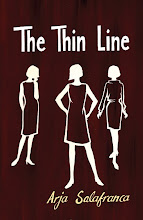
Review of The Thin Line

Real people have complex lives. The ones who, from the outside, look as though they are enjoying idyllic stress-free existences are often the sources of the most conflict. It takes work to look fine all the time. That’s often why love is such a respite – it’s an opportunity to relax the guard we construct for others. To breathe above the water, if only for a moment. But, it is reckless to believe in stability, always.

The Thin Line, a collection of short stories from South African writer Arja Salafranca, provides snapshots into the lives of real, flawed humans. Short stories seem to place more pressure on a sentence, and Salafranca’s prose is tight. Many of her descriptions had me nodding jealously, aptly capturing some characteristic of South Africanisms.

That is because these short stories are not only about people, but also reflect the changing context and themes of South African middle-class existence. The theme of crime, emigration, the fear of violence travel through many of the stories, revealing the characters through their reactions to these themes. Her devices are slick and impressive.

This collection is well-worth a read, especially for anyone who wants to write short fiction. I definitely learned a lot from her use of style and descriptions.

First published here

Friday, January 16, 2015

From the Fifteenth District by Mavis Gallant

The late Mavis Gallant's stories
are beguiling to read
The late Mavis Gallant’s stories are beguiling to read – they creep up on you slowly, until you find yourself devouring each mostly lengthy story, wanting more. This collection, first published in 1979, and now re-released at the end 2014 by Open Road Media, is peopled by ordinary characters, ordinary but for the fact that they are caught at the crossroads of European history, and their lives are shaped by the lengthy shadow of the second world war.

Comprising nine stories, the collection opens with ‘The Four Seasons’ which sets the tone for the atmosphere of these stories. They are located in a Europe battling to come to terms with the destruction wrought by the war, and the displacement of those lives affected profoundly by it.

In ‘The Four Seasons’, we are introduced to Carmela, somewhere on the French/Italian Riviera – the borders shift depending on who is in power, domestic maid to an English couple, the Unwins, and their three-year-old twins. Carmela becomes intertwined in their lives – to the point that towards the end she is no longer even receiving her salary. Chronically short of money, they promise when war breaks out that they will send her wages on, but we know that will never happen. Not quite friend, a maid who becomes entrenched in the family, the nervous Mrs Unwin relying on her more and more, Carmela draws on strengths the more privileged Unwins apparently have no access to. A compelling piece.

The effects come almost as a post-script

‘The Moslem Wife’, the second piece is a novella length tour de force. Netta Asher, the ‘Moslem wife’ of the title, takes over the lease of a hotel her father has run for years in the south of France. She marries her younger first cousin, Jack Ross, against her family’s wishes, but theirs is a happy marriage, bound by her loyalty to the business her father started, and Jack’s acceptance of life as the husband of a hotel manager, dabbling in his music. The atmosphere of a hotel on the French Riviera in the 1930s is vividly brought to life, and life flows slowly on, with its cast of characters, hotel guests, eccentrics who live at the coast and then Jack’s ailing mother who comes to stay. But war intervenes, once more, and as usual it will have a calamitous effect on all. The effects come almost as a post-script, long before that we are caught in the dramas of this world, Netta swirling at the circle of it all, and we, in turn, circle closer and closer to her.

In equally astounding ‘The Remission’ we are once more on the Riviera – this time with another English couple – Alec and Barbara Webb in the 1950s. Alec is dying and the National Health can do nothing more for him. And so they bring their three children with them, with Alec preparing to die in the sun.

A crumbling Edwardian home is purchased for them by family members, and they go down for what they believe will be a short time there. But the years drag on. Alec grows weaker and weaker; the children grow older and it’s the girl, Molly, who will be responsible for bringing another man, a part-time actor, into their mother’s lives. When Alec goes, as he will, he will barely be remembered, life carries on as it will, some lives leaving nothing behind but wisps. The hapless Barbara is not a conventionally attractive character with her reckless abandon, her laissez-faire attitude towards money and her children, but such is the strength of Gallant’s writing that we’re drawn to her despite all these failings, compulsively reading on, the light of the Riviera shining throughout the story, illuminating love, and the growth we all twist through as we go on through our lives.

It’s a squalid, post war world, where the bath is rough enough to scour you and the flat reeks of tiredness and poverty
Equally brilliant was ‘The Latehomecomer’. Here we are introduced to Thomas Bestermann in 1950, recently released back to Berlin after being a prisoner of war and being caught up in bureaucratic delays in France, like so many other ‘late homecomers’. He returns to the flat his mother now shares with her new husband, a detail she only tells him about when they are standing at the front door. It’s a squalid, post war world, where the bath is rough enough to scour you and the flat reeks of tiredness and poverty. His brother is still missing, and his mother, in her early forties, is tired and resigned, covering her smile when she laughs, hiding the missing teeth. Strangers now to each other, they must navigate that awful space between them, a place where words can’t correct the chasms of the past.

Gallant's talent shines in this collection of post war lives 

‘Potter’ meanwhile focuses closely on a fortysomething a Polish poet and translator who falls for a feckless twentysomething Canadian girl/woman, Laura. Piotr, called Potter by her, watches as Laura routinely disappears, goes off with another man to Venice, with reassurances that he’s only an ‘old friend’ although they might find themselves in bed together. Piotr has a wife back in Poland, but while that relationship continues to wither away, Laura rips him in two, and we follow his agonising destruction as love tears him apart: “He hesitated; where love was concerned he had lost his bearings.” A beautifully told story that gets to the heart of unrequited love and lust and takes us right into Piotr while also providing a glimpse into the enclosed world of an ex-pat Polish community in Paris.

A meditative piece, a story that moves slowly across a day – Christmas

In ‘His mother’ we peer through the glass inside a Budapest flat: a woman lives alone after her son has managed to get out to Scotland, this is back in the Communist days. He marries, has children and his mother watches from afar, her life filled with memories, the past, letters from her son, “the insignificant sadness of a lifetime” while she shares her flat with a grandfather, and his pregnant granddaughter. She cannot kick them out, they are too powerful, know too much.

In the last story, ‘Irina’ we’re in central Europe now, where a woman who was once married to a powerful man now lives out her days in a flat with a new companion. When her grandson Riri comes to stay, he discovers that life has changed even for her. This is a meditative piece, a story that moves slowly across a day – Christmas – in lives that are quiet, yet no less ‘insignificant’ than any others.

Gallant’s talent in this wonderful collection shines a powerful beam over these lives, over moments, days, decades where the world turns, and lives spin and change in the tumult of the times and all that’s left is to hold on, and accept.

Sunday, August 31, 2014

Adults Only teaser: Q&A with Arja Salafranca

Joanne Hichens – editor of the Adults Only, the second annual Short.Sharp.Stories Awards anthology – interviews Arja Salafranca.
Arja Salafranca has published two collections of poetry, A Life Stripped of Illusions, which received the Sanlam Award for poetry and The Fire in which we Burn; a third is forthcoming in 2014. Her debut collection of short fiction is titled The Thin Line, and long-listed for the Wole Soyinka Award in 2012. She has participated in a number of writers conferences, edited two anthologies of fiction and non-fiction, and has received awards for her poetry and fiction. She is the lifestyle and arts editor at The Sunday Independent. Find her online atarjasalafranca.blogspot.com.
So… a collection of sexy stories… what’s your take?
Sex is everywhere around us – seemingly – on television and billboards, online and elsewhere – and yet, you don’t find much of it in literary terms, it’s something only partially explored in SA writing – and so I think this volume will be a welcome addition to the literary canon.... Read more here

Thursday, February 9, 2012

Meditative and moving

Reviewing Alice, five interlinked short stories by Judith Hermann 

German writer Judith Hermann examines the loss of a loved one through these five interlinked short narratives in Alice (The Clerkenwell Press). Her gaze is cool, detached, the writing style almost blandly obvious. The central character of Alice seems ephemeral: she appears in each story, death is linked to her through her relationship to each dying character: whether a friend’s husband is dying, or whether an old friend, a man in his seventies, is about to pass on.

We get to know and empathise with Alice through the layering of these stories, like burrowing down deep into the text, until, by the final story, the one whose loss recounts a man central to Alice’s existence, we feel we have, at last, become acquainted with the character who moves so centrally, so determinedly through these narratives. It’s gratifying, this slow peeling away at the onion skin of Alice; at last, there’s a sense of completion. Death is a character, a fact, early on, yet these stories are as much about loss as the central figure of Alice. 

The first of these stories, Misha, concerns the death of a young man, Misha, husband to Maja, father to his and Maja’s daughter, who remains unnamed. Alice is a sometime lover of Misha, and her relationship to Maja, the soon to be widow, is a rather awkward one.

Friendship would be too strong a term, acquaintanceship too distant. After all, acquaintances don’t take trains and temporarily relocate in order to help Maja care for her child in another city where Misha lies dying in a hospital. In fact, the uncertain boundaries of their relationship are never explained, but rather gently hinted at, a device Hermann uses often in this collection. 

Hermann’s gentle, delicate, almost watercolour gaze is reflected early on, the narrative reading at times like a dream. She eschews quotation marks for direct speech, which, for me, always adds a somewhat dreamy quality to a story.

Misha, the man, lies dying in a hospital not far from the flat where Alice, Maja and the child go through the motions of the days; death looms large, preparations both mental and emotional are being made. Yet this lends a rigidity and stiffness to the everyday actions of eating, drinking, visiting a dying man. Everything is not what it seems, although the mundanity of quotidian details belies this. 
When the threesome move to a bigger flat, they are greeted by their new landlords and Alice is immediately struck by the scars on the side of the man’s face: “It looked peculiar, but then everything seemed peculiar, had to be accepted for what it was. Alice carried her bag into the front garden and up the broken paving stones of the front path while the child on Maja’s arm kept saying, Rabbit. Rabbit. Rabbit. As if to calm everyone.” Through such almost throwaway lines Hermann indicates the strangeness of the wait for a young man’s death. Later on she thinks to herself, “astronauts. We’re just like astronauts, there’s no place to hold on to”. In this world of death and dying there are no rules, and nothing to grab on to. 

In the second story, Conrad, Alice travels with two friends from Germany to the Italian home of her elderly friends, Conrad and Lotte. She is travelling with her friend Anna (“she didn’t want to go anywhere without Anna”) and another male friend, simply called the Romanian. 

The setting is beautiful, the villa magical, the lake gorgeous with its cold water in the heat of an Italian summer, and yet, once more, death and uncertainty hover. When they arrive Lotte informs the trio that Conrad is a little unwell. A little unwell turns deadly, and once more a hospital becomes the centrifugal force for the action. While the trio enjoy their holiday, soaking up the sun, there’s the underlying awareness that a man is passing from this life. And yet, there’s little that is morbid or negative about this story, or any of the others that follow on. Death as a character, death as part of life, as Hermann appears to be saying. It lends an unsettling air to life, yet we carry on reading. Alice grows stronger, comes into focus as we read on, and our attention remains riveted on her; she is most certainly fully, and richly, alive as the narrative attests, and so while death is the link, it’s Alice’s life that leads us.

In the third, Richard, a friend is again in need. Richard, the husband of Margaret, dying of cancer in midlife, Margaret phoning, needing cigarettes. Through it all, the vibrant summer of Berlin swirls around Alice, introducing us to her live-in lover, Raymond. Once more we are being led further into Alice’s life. And further still in the fourth story, Malte, as Alice uncovers family history, finally researching the life of her unknown gay uncle Malte, who committed suicide. She meets Frederick, her uncle’s lover from the 1960s, now a man of seventy something, dignified in his sharing of secrets and reminisces. 

And then, the final story, Raymond. We witness Alice as an older woman now and her lover, Raymond, passes on. We’re deep into the depths of Alice’s character as she grieves. She matter-of-factly starts to get rid of his things, but grief catches you when you least expect it. She finds that “she couldn’t choose the memories; they came of their own accord; the memory of the garden, Raymond in the aviator jacket – soundless and yet part of it all”. When she discovers a dried piece of an almond horn, she crumples – small, everyday, innocuous objects have the power of memory, and remind one of loss, grief. This is a moving, meditative piece. 

This is the closest person in Alice’s life, as we move through the early, raw stages of her loss, “the days would never again be this clear and luminous; maybe she would have to learn how to find pleasure in it; any other way was impossible”.
 
First published in The Sunday Independent, January 22 2012

Friday, November 4, 2011

Voila! chatroom: an interview with Arja Salafranca, by Nikki Temkin


Arja Salafranca selected the short stories for The Edge of Things, a compilation of South African short stories. I chatted to her.

NIKKI:  What were the criteria for selection forThe Edge of Things?
ARJA: Firstly, a story had to move and touch me, make me feel something, reflect on some aspects of life and our experiences here. Secondly, I was looking at excellence in terms of telling a story, well-crafted stories that begin with something deep inside and move readers because these were tales that just had to be told.

N: What was the inspiration for this book?
A: The book was initially meant to be an edition of the literary journal, Green Dragon. I received nearly 100 submissions and then selected the 24 stories that make up the anthology. It was too large for a journal, so I suggested that it become a special short fiction edition. I decided to do it because of my own love of the short story – as both a short story writer and as a prodigious reader of the genre.

N: Can you tell us about some of the themes of the book?
A: Some of the stories centre on solitude – and the ramifications of that, from loneliness, to a sense of fulfilment that also results from time spent alone, some centre on relationships experienced, some are about the outsider from society. Some of the stories explore the mother-daughter bond, some look at childhood experiences, some reach deep into South Africa’s past, looking at how those experiences have shaped those in the stories. Others look at identity issues in post-apartheid South Africa, and my own story deals with polio and the mother-daughter bond.

N: What do you think of South African writing currently?
A: It’s extremely vibrant and healthy – certainly in terms of the volume of fiction being produced, and we have some world-class writers, both established as well as emerging. South Africans are now so much more receptive to reading local literature – and there’s also such a range – from literary, to science fiction to crime thrillers and more.

N: Who are some of your favourite local authors?
A: I love Damon Galgut’s fierce, spare, almost uncompromising vision; David Medalie’s collection of short stories The Mistress’s Dog as well as Henrietta Rose-Innes’s Homing. I also love the poetry of Eva Bezwoda Royston (sadly she committed suicide in the 1970s). It’s personal, confessional poetry full of rich, dark and vivid imagery.

(Published in Voila!, Issue Number 8, 2011) 

Thursday, July 14, 2011

Loneliness a recurring theme in this collection: a review of The Edge of Things, by Gwen Podbrey

The short story has come back into its own over the past few years, possibly because time-strapped readers find them easier to manage than a lengthy novel.

This collection includes contributions from a remarkably diverse range of writers, including Gail Dendy, Jenna Mervis, Gillian Schutte and Jayne Bauling.

If there is one central theme to the book, it is alienation (or, to use real name, loneliness). The stories capture encounters and experiences which tilt us over into the cracks between the crevices of contemporary life: those dark, uncharted spaces where needs are failed by niceties, and pain and perdition walk hand in hand.

Pick of the crop – by a long way – is Bernard Levinson’s superb “Tokai”, which recounts his delivery of an Afrikaans couple, the Bezuidenhout’s, baby in the dead of night. But the birth is complicated and the womb goes into violent contractions, forcing him to manually secure it and staunch its gushing of blood.

For hours he sits, his hand in the uterus of his semi-comatose patient, feeling this incubator of life convulse, enfold his fingers and relay to him its arcana.

“There was a slight shift of tempo. I listened with the fingers of my fist. Unmistakably, I heard the womb flutter and shift itself minutely over my fist... It stretched and gripped. Stretched again and squeezed my fist firmly. I inched my hand out. A secret dialogue between my hand and the womb. My blunt fist - mute and solid. The womb excited, chattering and intimately pressing and caressing my hand.”

Witnessing the drama of this birth - like the primordial one and, indeed, all births - Kleinman Bezuidenhout is engulfed in agony as acute as his wife’s. The next morning, Levinson - preparing to leave - sees him engaged in a ritual which matches, in every detail, the intensity and power of the previous night’s crisis.

The story is an unforgettable glimpse into the soul of the healer, whose patients’ trust in him can crucify as often as it coronates, and whose brief role in their lives - as an outsider, observing and intervening, but never sharing - carries a unique loneliness.

Later, in Liesl Jobson’s “You Pay for the View: Twenty Tips for Super Pics”, we enter the alienation of a compulsive photographer unable to fully engage with her life, and attempting instead to capture its essence through her lens “because the camera never lies”.

Yet it does, for it lacks the vocabulary to capture the truth of locations and individuals, how they imbed themselves in the DNA of the soul and remain there forever, a testimony to life and loss. These are not within the province of pixel and resolution, but of another documenting medium altogether.

The third exceptional story in the collection, Pravasan Pillay’s “Mr Essop”, recounts the arrival of a seemingly kindly, placid lodger at his parents’ home. The author, still a child, notes the growing friendship between the boarder (Mr Essop) and his father - both lonely men - and their mutual pleasure at discovering the values they have in common. But when Essop suddenly shows a brutal side to his nature, shock is added to disappointment.

Aryan Kaganof’s “Same Difference” explores yet another kind of alienation: that of drug users, whose subculture and exclusion from mainstream society force them to band together, unwillingly recognising in each other kindred tortured spirits and putting on a show of bravado to conceal their desperation.

In this ugly, treacherous world, the only allegiances which matter, last as long as it takes to shoot up a crystal meth hit.

“The upstairs toilets are for blowjobs and the schnarf sessions. The outside toilets are for quick shags and schnarf sessions … Tretchikoff girls clustered on the walls and in the mirror. Looking down serenely on the useless lives of all the pastel customers. Useless, all of it. Useless.”

As the narrator ends yet another all-night session with his gang of users in the fetid, filthy basement of a nightclub, and the sun announces the break of yet another unwelcome day, he reflects: “I’m frightened. I’m lonely. Sometimes I feel close to death. But at least I scored tonight… There is no reason to stay alive. But I refuse to bribe the reaper to come and take me.”

Hans Pienaar’s contribution, Telephoning the Enemy”, makes a brave, but failed, effort to explore the alienation of white, apartheid-bound South Africans on the verge of political change. As bombs hidden in sidewalk garbage cans claim one civilian victim after another during the early 1980s, racist beliefs are heightened and the gap between terrorist and victim appears unbreachable.

Not all the stories have the gravitas or compositional skill to sustain the reader’s interest. Angelina N Sithebe’s cumbersome, melodramatic and poorly structured “Sepia”, for example, features characters who are utterly implausible, while Rosemund Handler’s “Clueless” exhumes a stale, clichéd story line: white, lonely madam coming on to a man across the colour bar, followed by a delicious explosion of eroticism and new awareness of each other as human beings. Hardly groundbreaking stuff.

Still, with 22 out of 24 stories offering piercing insights and showcasing a range of exciting writing talent, the collection is one of the best to emerge in recent years. Salafranca’s eloquent and moving foreword whet one’s appetite for the feast to come and the contributors’ profiles at the back of the book give perspective to the voices on the pages, which demand - and deserve - an audience.

(Published in SA Jewish Report, July 8, 2001)

Thursday, June 23, 2011

Invite to the Cape Town launch of The Edge of Things, at The Book Lounge, July 28th

Extracts from The Edge of Things on Peony Moon

The Edge of Things (Dye Hard Press, 2011) consists of 24 South African short stories selected by Arja Salafranca.

The contributors are Jayne Bauling, Arja Salafranca, Liesl Jobson, Gillian Schutte, Karina Magdalena Szczurek, Jenna Mervis, Jennifer Lean, Fred de Vries, Margie Orford, Aryan Kaganof, Bernard Levinson, Hamilton Wende, Pravasan Pillay, Beatrice Lamwaka, Hans Pienaar, Rosemund Handler, Tiah Beautement, Angelina N Sithebe, Jeanne Hromnik, David wa Maahlamela, Perd Booysen, Gail Dendy, Silke Heiss and Dan Wylie...Read more here

Thursday, June 16, 2011

Arja Salafranca, editor of The Edge of Things, answers a few questions about life, the universe and short stories

The Edge of Things is an eclectic collection of short stories traversing a vast distance emotionally and intellectually.

For example, Arja Salafranca’s moving story about a woman forced to live in a restrictive apparatus in “Iron Lung” is a million miles away stylistically from Aryan Kaganof’s tale of decadence and debauchery on a night out in Durban in “Same Difference.”

As with all anthologies, some stories will resonate with each reader more than others...Read more here

Jeanne Hromnik's review of The Edge of Things

There are 24 pieces here, some of which qualify as short stories, others more like prose poems and descriptions of emotional experiences. Relationships are central, aloneness integral and fictional reality
flexible.

The collection displays a variety of writing styles. It includes pieces by some of South Africa’s well-known writers, but also some gems from lesser knowns, including Beatrice Lamwaka’s prize-worthy Trophy and Dan Wylie’s tour-de-force, Solitude.

Interesting reading for those who are curious about the advance of short fiction in the local publishing market and, for all, comfort food for the soul. Jeanne Hromnik

(Published in Cape Times, June 10, 2011)

Monday, May 16, 2011

The Edge of Things: South African short fiction selected by Arja Salafranca


ISBN: 978-0-620-49506-6
The Edge of Things consists of 24 South African short stories selected by Arja Salafranca, and is published by Dye Hard Press.

The authors are Jayne Bauling, Arja Salafranca, Liesl Jobson, Gillian Schutte, Karina Magdalena Szczurek, Jenna Mervis, Jennifer Lean, Fred de Vries, Margie Orford, Aryan Kaganof, Bernard Levinson, Hamilton Wende, Pravasan Pillay, Beatrice Lamwaka, Hans Pienaar, Rosemund Handler, Tiah Beautement, Angelina N Sithebe, Jeanne Hromnik, David wa Maahlamela, Perd Booysen, Gail Dendy, Silke Heiss and Dan Wylie.

280 pages.

Will soon be available from bookstores countrywide, estimated retail price R185.

Sunday, April 10, 2011

Review of The Best American Short Stories 2010, edited by Richard Russo

The Best American series, for those unfamiliar with it, consists of a range of stories published in US and Canadian journals from the previous year. About a hundred of these are then read and selected by the guest editor, and, in this year’s case, Richard Russo did the choosing, selecting a final list of 20 stories, now collected in this volume.

I found the stories in this volume exceptionally compelling and readable – with many being of the über-lengthy variety, running to many pages, with the writers taking time to tell the tales, really letting each story breathe and glow...Read more here 

Tuesday, January 18, 2011

Flash fiction

100 Papers: A collection of prose poems and flash fiction by Liesl Jobson
Botsotso Publishing, 2008

“A pale pink slug emerges from between Josie’s teeth onto the dental floss that is wrapped so tightly around her thumbs that they bulge like purple grapes. ... When she pulls the floss between them, it snags... When she gets it right, the floss slides down without bumping her gums, the slugs are a pale creamy colour.”

So opens one of prose poems in “The Air of Words” in Liesl Jobson’s debut collection, comprised mainly of flash fiction and some prose poems. This piece is short, yet powerful, its images stay with you, from pale slugs of teeth detritus that turn pink with the blood coming from gums, to the larger issue of why Josie, the central figure in this drama of the flossing teeth, cannot eat and cannot say certain things.

And such is the power of many of the prose poems in 100 Papers. Another memorable one being the delightfully named “Sun-Dried Tomatoes” in which “droopy carrots” on a clothesline, along with “tomatoes and peppers flapping in the breeze” recall in a few, quick sentences what it means to have a mother who plants “father’s socks and shirts in the vegetable patch”. A witty poem that goes deep with its vegetable metaphors.

Another equally clever and moving prose poem is “Under my SAPS heart” where a kindly captain at Diepkloof’s Alien Investigations Unit recovers the narrator’s heart from a defunct fountain. “So pale, so under-developed it could only be a white girl’s heart”. In a few witty paragraphs we learn that the captain washes the heart of detritus before replacing the item: “The State will not be held responsible for such silliness in future.”

On the other extreme is “Button” in which marital abuse is highlighted in a few, deft strokes, in three paragraphs to be precise. Short, but memorable.

Meanwhile “Clutter” delights with its descriptions of items left in a large ceramic jar near the kitchen sink. Each item is representative of some person in the narrator’s life: a gift from an ex-husband, children’s milk teeth, a student “taught badly”. But the listing of all these items has a purpose in itself, as absolution may be obtained in the end. This is one of the most powerful prose poems in the collection, talking as it does of the universal problem of clutter that litters our lives and psyches, growing even as we try to move beyond the mounds of it.

With origins that stretch back in time to the days of Aesop’s Fables and Ovid, practitioners of the flash fiction form have included writers such as Anton Chekhov, O Henry, Ray Bradbury, Amy Hempel and Grace Paley. Yet, it’s only since the early 1990s that flash fiction has become so popular. Some say the growth of the internet has helped to spread its popularity: readers online are looking for a “quick fix”, not a lengthy, meandering story. Whatever the reasons, flash fiction has taken off in a big way. WW Norton in the US published the volume Flash Fiction in June 1992, and Tom Hazuka, one of the editors, says “initial response was overwhelmingly positive”. To date it has sold 22 000 copies and is in its fifth printing.

To my knowledge this is the first collection of flash fiction by a South African author. Anne Schuster was a pioneer in that she published Woman Flashing in 2005, a collection of flash fiction by women writers, but 100 Papers marks not only Jobson’s debut, but the debut of a collection flash fiction by a single author. What exactly is flash fiction? Experts – and readers and writers differ. At the launch of her collection in Johannesburg this past July, Jobson said that flash fiction was a highly poetic genre and described it as a “tricky beast”. Some publications call for flash fiction and set a word limit of 1 500. Most flash fiction pieces are from anything from less than 400 words for micro fiction, to up to 1 000 words long. Even the name itself is not fixed: it’s called anything from micro fiction, to flash fiction, postcard fiction, sudden fiction and so on. Says Camille Renshaw: “Readers discover something brief and intimate in a very short space of time. Meanwhile Randall Brown says “Great flash pieces have that ‘centerlight pop’.”

Jobson’s flash fiction world is largely a domestic one, with a few recurring themes, the divorced mother, whose children live with their father, infidelity and its effects, love and its rewards, and the milieu of families, which are not always cosy.

“Pickle” is one such story that takes a look at a divorced mother whose ex-husband has custody of the children. Seeing them only on alternate weekends, the mother tries, “she is trying to get it right. She really is, but it’s a big job looking after her children... There’s a lot of catching up to do for the other twelve days, the lost time. That’s the hard part.” This mother has a secret; she likes to finish cartons of ice-cream, leaving the healthy vegetables bought for herself and the kids to go mouldy. “The mother is tired, permanently blah. She hasn’t slept in weeks, maybe years.” This is a sensitively-wrought portrait of a mother, doing her best, trying to be a mother for two days out of every fortnight, sending jolly text messages to convey her love on the days she doesn’t see her children. An excellent piece.

“My Mother’s Diary” is a touching look at the narrator’s mother, writing as a young girl in 1970, interwoven with the daughter’s memories of girlhood from that time. It’s not as easy time for the ten year old with enormous breasts, called ‘Tits Tessa’ by the pre-pubescent male classmates, and meanwhile the police come regularly looking for her mother’s lover Koos, not white, in an apartheid South Africa. Jail, and then years later, Tessa releases her mother’s memory and ashes to the wind in poignant prose.

In “Duet” the unnamed narrator finds herself in a psychiatric ward after a man puts a gun to her head. “...I heard a click. Not the click of a trigger. I never heard that... The gunman’s finger played with the safety catch of his glock: flick-flick-flicking, like playing with a ballpoint.” What follows is a description of life in a mental ward where “a linen basket on castors” talks, there’s blood everywhere as a fellow patient tries to carve a heart on the narrator’s arm. This gripping story takes you right within the madness and confines of such a ward.

But there are lighter moment as well in this collection, as well as a bit of erotica. “Christmas Eve Picnic, Pretoria” offers a small moment in the life of two women lovers. It’s an imagining of the picnic to come, words are charged with sexual meaning and a delicious playfulness. “You place a round of Brie, pale as your breast, beside a salad of herbs...hanepoot grapes, fat as your nipple.” The real present comes after the picnic of course, and after love-making.

Or there’s “The Virtue of the Potted Fern”. The opening line, as always, sets the scene for what’s to come: “It’s not easy to organise a bookshelf that’s been moved from the guest room to your bedroom because your South African relatives are coming to stay.” You must be ruthless as you keep the I-Ching away from the Children of Heaven, and don’t put the Healing Back Pain next to The Story of O. Working in the dark, “Like the rules for entertaining foreign in-laws, they do not exist.” Instead perhaps put a potted fern by the bed, surely a quieter option.


Returning to Randall Brown’s assertion that good flash fiction has that “centerlight pop”, do Jobson’s pieces have that pop? I believe that many do. For my money, some work better than others, and I felt some resonated more than others, but each reader will have their favourite.


Research sources:
www.english.ucdavis.edu/spark/issue3/thflash.htm (for Tom Hazuka’s comments)
www.pifmagazine.com/SID/313 (for Camille Renshaw’s comments)
www.smokelong.com/features/012605.asp (for Randall Brown’s comments)

First published in New Contrast, 2008

Deftly summons human frailties of New Yorkers

The Last Bachelor by Jay McInerney
Bloomsbury R279,95

This is the latest collection of short stories by Jay McInerney, who shot to prominence in 1984 with the publication of Bright Lights, Big City. The collection, largely peopled by those who call New York or its neighbouring environs home, is clearly set in a post 9/11 world.

While one story, 'I Love you, Honey', directly deals with the events of that day, there are oblique references to the day that changed America forever, and scarred that country and New Yorkers.

But this is not a collection about that tragic day, or its aftermath. It's a book peopled by ordinary people doing all the things that people do: bruise and punish each other with their infidelities, set out to marry rich men and have Thanksgiving parties where the muck of the past is raked through with regularity.

Although it's set mainly in New York, several of the characters have roots in the South, and the languid, humid South is contrasted with the more frenetic, neurotic mores of the north.

There are some lighter, fun pieces too, and McInerney shows a witty hand in 'Summary Judgement' in which a social climber who has "passed the first blush of youth", sets out to capture a rich man after the death of her husband leaves her in debt. The story is cattily delicious: there are hints of impropriety in Alysha de Sante's past, there are underhand dealings as she sets out to snag a businessman, and we watch as she reels him in, and cheer when she makes a fatal error.

Infidelity and its effects are dealt with in three of the stories, the aforementioned 'I Love you, Honey', 'Invisible Fences' and 'Putting Daisy Down'. In each of these tightly constructed tales, the married couples punish each other in ways that are scarcely imaginable. A woman has abortions to punish the wandering eye of her husband in the ironically titled, 'I Love you, Honey'; in 'Putting Daisy Down', a title that gives away the ending, a woman demands her husband put his 10-year-old cat to sleep, but pays the price as the story closes, and again we cheer.

Meanwhile, in 'Invisible Fences' Susan must pay the price for her infidelity as she and her husband start picking up men in bars to take home at night.

Observes her husband Dean: "When you're playing outside the regular borders, it's important to have rules and boundaries." But playing outside of the rules doesn't always lead to happiness: "I made her tell me everything. I was tortured by visions of her treachery, by my own roiling filthy imagination ? until we both realised that the actual circumstances would never be enough to match the visions in my head."

In 'The Madonna of Turkey Season' we are introduced to a family who have lost their mother and wife to cancer. The scene is played with yearly frequency: the father becoming maudlin, the brothers pushing against each other in ways that cannot be forgiven. At the heart of the story is the unhappiness the family feels over one of the brothers, Brian, who has written a play, subsequently made into a film, which explores the death of their mother and introduces a note of infidelity in the relationship of the parents.

It's hard to make doubt disappear once the seed has been planted, and hard to forgive the brother for planting the seed. Hard too, not to believe that Brian may have been privy to a deathbed confession none of the others were witness to. And it's hard to see the failings of a mother who has died too young: "We always believed in you Mother, more than anything, but we never for a moment thought you were human."

In 'Penelope on the Pond' a woman waits in a remote pond for her lover, a senator campaigning for the president, and yet to announce a forthcoming divorce. Out of sight of the tabloids, it's ultimately not the blogger journalist who will drive a knife into their relationship, but the smooth-talking wannabe president himself.

In the quietly thoughtful 'The Last Bachelor' Ginny encounters her long lost lover, AG, in the weekend before his first marriage at the ripe age of 40. The story passes back in time, detailing the dalliances of AG, who feels it's time to finally settle down.

When he visits Ginny the night before his nuptials, bringing lines of coke, old secrets are revealed, old loves given an audience. This is a tender, wise story, somewhat sad in execution. And sometimes, seems to be the message of the story, it really is too late to do the right thing.

Published in The Star, Tonight, February 26 2009

Fiction with the sting of fact

Too Much Happiness by Alice Munro (Random House/Struik R300)

Alice Munro is one of our contemporary masters of the short story, who has made her literary reputation through her crafting of short fiction, that often-neglected and under-valued genre. This year, she was awarded the third Man Booker International Prize for her overall contribution to international fiction, an accolade which firmly cements her reputation.

In Too Much Happiness, her latest collection, Munro once again mostly focuses on the lives of her fellow Canadians, barring the novella-length piece which closes the book. Hers is a gaze that is tender and compassionate, a gaze that bathes her stories in a sensitivity that is acutely felt.
This is not a writer who judges her characters, nor does she mete out punitive actions.

There is suffering, then again, there is always suffering when casting an eye over the human condition, but we feel that Munro's characters are well taken care of, gently led from beginning to end.

And yet, there is darkness in Munro's stories. Her simple story-telling hides the truth of the sorrow that is out there, presenting portraits that are seemingly simple, innocuous tales.
I've long been a fan of Munro, and have read all her collections. But, strangely, there's a darkness in these stories that I haven't noticed in her previous volumes, and which makes reading Too Much Happiness an interesting experience.

However, there is also a truth that we all recognise once we reach the final line of so many of these stories.

The opening story, 'Dimensions', highlights the recent tragic events in the life of Doree, a young woman who has to take three buses to reach the prison where her husband is held. She is working as a chamber maid, has changed her appearance by bleaching her hair and losing weight and is seeing a counsellor.

She is in the throes of change, a change brought on by tragedy, which is only slowly, and horrifying revealed as the story unfolds. A moment in time helps the healing, and although time will continue to heal, we feel, life is rarely that cut and dried.

In 'Fiction' Munro cleverly contrasts the world of fiction with that of reality. The story is told in two parts, sometime at the cusp of the 1980s and today.

What is remembered, and noticed, differs according to whom is doing the remembering. In this story Joyce divorces her husband when he has an affair.

Years later, at a party she gives with her second husband, she meets a young woman, a writer who has just published her first book.

When Joyce reads it, she gasps at what the woman, a child from her own past, has written. But the young writer does not recognise Joyce, barely acknowledges her.

Meanwhile, Wenlock Edge, set in a long-ago 1950s of university students sharing digs, is a strangely unsettling narrative.

The unnamed narrator is paying her studies by working in the university canteen and living cheaply.

When she is forced to share with the quiet, yet compelling Nina, she is introduced to a world that is far from pin set suits and propriety.

Yet, the story unfolds gradually: we are made aware of the hold that people have on each other, and the loyalty that binds them.

People are strange, no more strange than Mr Purvis, who prefers that women read poetry to him in the nude. A compelling, utterly memorable piece.

Both 'Free Radicals' and 'Face' present shocking, yet totally believable portraits of ordinary people living ordinary lives yet hiding secrets and afflictions which subtly twist the dynamics of their interactions.

In 'Free Radicals' Nita has just, unexpectedly, lost her husband. Yet, when an intruder bursts into her home, we learn her secret; the reasons are compellingly believable, and we even cheer her on. In 'Face' the damage inflicted on one born with a livid birthmark is re-lived, a damage that waxes and wanes and yet determines a person's life.

The damage that other people do is again the subject of another story, 'Child's Play', a story of children who engage in action that is anything but childish, and yet is also firmly anchored in that world of seeming innocence.

The novella-length 'Too Much Happiness' is a strangely compelling tale, although the focus this time is on Sophia Kovalevsky, a Russian mathematician and novelist in 1891, a time when mathematicians had to be male, and females in this decidedly masculine environment suffered for having been born so.

The fiction examines aspects of her life, her love affair with a man who was reluctant to commit to her, and a final, perilous journey to Stockholm. It's a bitter sweet story, a story which opens new avenues of interest in a woman whose name now lends itself to a crater on the moon.

Published December 21 2009 in Pretoria News

A strong narrative set in rural SA

The Angina Monologues by Rosamund Kendal (Jacana, R145)

Rosamund Kendal's second novel, The Angina Monologues deals, as did her debut, with the trials and tribulations of being a modern doctor in today's South Africa. Like the first, Karma Suture, it also has a deliciously witty title.

The Angina Monologues centres on three young women interns who are completing compulsory medical community service in rural KwaZulu-Natal, at Prince Xoliswe hospital, in a one-horse town. Each is vastly different, and we follow their lives and struggles with life in a decaying hospital, decay which is made worse by the corruption practised by those in charge. We are introduced to each in separate chapters.

There's Rachael, spoilt and rich. We meet her as she wanders disconsolately around her spartan doctor's quarters, trying to figure out how to make water emerge from the taps. You pump it yourself, of course, or pay the dagga-smoking gardener to do it for you. Shock number one. Yet Rachael is determined to make a go of her community service and to stick it out. Not an easy task when she is beset by her parents at every turn, her neurotic Jewish mother in particular, imploring her to pack up, return to Cape Town and board the first plane to London where she can find a job as a doctor, and a husband too, hopefully.

In contrast to the wild and funny Rachael is the conservative, quiet young wife Seema. Passionately dedicated to her vocation as a doctor, and a brilliant medic, she harbours a painful secret. Her husband Satesh is both insanely jealous of her abilities, and abusive in his jealousy and his lack of love for her. But for Seema to abandon her marriage would mean incurring her family's wrath and alienation. She struggles poignantly with these dilemmas throughout the story.

Then there's Nomsa: feisty, ambitious, and equally passionate about her calling. And yet she too is caught between two worlds - an education in Cape Town away from her family in Aliwal North means that she feels alienated from her home and her rural, illiterate mother. But her mother is sick and Nomsa must return home and face the family she loves with a fierce sense of pride, yet returning means awakening a mass of contradictions within her.

Nomsa's portrait is finely drawn - I found her the most compelling of the three. The tensions that threaten to tear her apart are sensitively revealed.

It is only fairly late in the narrative that the three meet up, becoming more friendly with each other, and I couldn't help wishing that this had happened earlier on in the story. Part of the joy of each woman's life is in the connections they have made with each other, and this forms part of the enjoyment of the reading.

A very apt and large part of the story is Kendal's explanation of conditions at a rural hospital, which are shocking, to say the least. The stories of the various patients are also woven into the novel, and some of the stories are heartbreaking, especially in cases where private, expensive medical care could have saved lives.

Kendal, a medical doctor herself, knows what she is talking about, and her fiction exposes the truths and deceptions in an entertaining, yet ultimately shocking way.

Kudos to her for doing it so cleverly and for uncovering the facts that need to be exposed.

At the end of the year the threads of these young women's lives coalesce in a number of decisions made, and realisations achieved. This is a delightful, witty, entertaining read - serious truths are explored, and lives are deftly and intelligently explored in this strong narrative.

Published in The Star Tonight September 23 2010 and Pretoria News September 27 2010

Tenderly distilling time's essence

Homing: Short Stories Henrietta Rose-Innes (Umuzi: R170) Henrietta Rose-Innes's debut collection of short fiction spans stories written from the mid- 1990s to the present day, and is a welcome addition to her work. She has also written two novels, with a third forthcoming next year. There are several moving and memorable stories, distilled essences of a particular time in the characters' lives, highlighting a pivotal point upon which a realisation is made and a life turns, for better or worse. Many of the stories take place in Rose-Innes's home town, Cape Town, or in locales near the city, and the city becomes a subtle background to the themes explored. Rose-Innes's work is highly visual and when I recall the first story in this powerful collection, 'Homing', I immediately think in terms of the pictures painted by this writer. Homing is a strange, haunting story about retired couple, Nona and Ray, who happen to live a few doors away from a face-brick retirement home, a home both suppose they will eventually move into. But then the home closes and in its place "reared the pink backside of a new hotel". The building wreaks all sorts of changes, including altering the play of light during the day, inverting the normal order of things. Then Nona decides to spend a night in the hotel, telling Ray she is going away. She secretly strolls down the road to stay in this new monstrosity, from where she will be able to view their humble home from the vantage point of this new swish place. Enter a flock of homing pigeons who surreally surround Nona in her hotel room. Home is indeed altered when you look at it from afar. All sorts of faults become evident and you yourself are changed by the experience. 'The Leopard Trap' is another strangely disaffecting story which revolves around Daniela who's "taken to leaving town when things got bad", escaping from the violent, unexplainable rages of her husband Thom. While away, staying at a bed and breakfast near Sutherland, she chances on a leopard trap and her fear is visceral, animal-like: "Her cheek touched stone. And all at once it grasped her: the horror of the trapped creature, of the trap, this box precisely measured out for her own length and breadth?" The fear dissolves and she stares coolly at the trap within the landscape. Daniela returns to her husband, as she must, as she always does, in this story in which a trap to "take a living cat and turn it into bones and pelt" becomes a startling metaphor for a marriage trapped within itself. 'Burning Buildings' is another story which examines the bounds of a relationship, this time between Hein and Anna. Hein is into matchstick building, constructing elaborate buildings and castles, which are then burnt outdoors, the couple watching the towers of destruction, bound by their mutual fascination, Hein's streak of destruction uniting them and yet also tearing a rift through their lives. This is a story in which the props do not trap the lovers, but instead, ultimately set them free. 'Tremble' takes place within the confines of a singles weekend. Erin is only on this cheesy, getting-to-know-you jaunt because her friend Alice persuades her to accompany her. The place is luxurious, safe, framed by mountainside vineyards, "and everyone was white, middle class, of an age. That was, she supposed, what she had requested. She'd known these people all her life". The past collides with the present as Erin finds herself reaching across the age gap that separates her from a teenage boy. This is a story about a certain age - that gap between youth and before the onset of middle age, when time may be running out, and people are burdened with "excess weight, the first strands of grey" and "caution and worldliness". And yet, time to try again: a story that probes the spaces between wanting and not having. There is again an element of the surreal, which nevertheless edges back into reality, in 'Bad Places'. Three young people have attended a party dressed as mermaids. Elly wakes up on the beach, her friends asleep, the blue pigment having seeped into the sand, cobalt skin bleeding into beige. Leaving her friends sleeping, she encounters a "bergie" in his makeshift beach hut - and the few moments of that encounter will shape and alter her forever. The final story in the collection is the tour de force and the Caine Prize-winning 'Poison'. In this excellent apocalyptic story, Lynn finds herself fleeing Cape Town after a mysterious disaster has resulted in the city becoming contaminated, with residents fleeing in panic as fast and as far as they can. Lynn lands up at a near-deserted petrol station and finds herself stranded in this empty world which is "poison violet and puce". Sometimes there really is nothing left to do but to abandon yourself to the violent, apocalyptic worlds you find yourself stranded in. A mere telling of the events doesn't do justice to a story that is haunting in its simplicity and continues to resonate. It's a story of extraordinary power: a description that fits much of Rose-Innes's short fiction in this excellent volume. Published in The Star Tonight, October 28 2010

Saturday, January 15, 2011

Forthcoming publication from Dye Hard Press: The Edge of Things

The Edge of Things is a special issue of Green Dragon, to be published by Dye Hard Press, and consists of 24 short stories selected by Arja Salafranca. The authors are Jayne Bauling, Arja Salafranca, Liesl Jobson, Gillian Schutte, Karina Magdalena Szczurek, Jenna Mervis, Jennifer Lean, Fred de Vries, Margie Orford, Aryan Kaganof, Bernard Levinson, Hamilton Wende, Pravasan Pillay, Beatrice Lakwana, Hans Pienaar, Rosemund Handler, Tiah Beautement, Angelina N Sithebe, Jeanne Hromnik, David wa Maahlamela, Perd Booysen, Gail Dendy, Silke Heiss and Dan Wylie.

Publication is scheduled for March 2011.
More details to follow.