Showing posts with label The Thin Line. Show all posts

Sunday, June 7, 2015

Review of The Thin Line

Real people have complex lives. The ones who, from the outside, look as though they are enjoying idyllic stress-free existences are often the sources of the most conflict. It takes work to look fine all the time. That’s often why love is such a respite – it’s an opportunity to relax the guard we construct for others. To breathe above the water, if only for a moment. But, it is reckless to believe in stability, always.

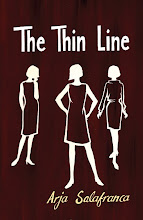
The Thin Line, a collection of short stories from South African writer Arja Salafranca, provides snapshots into the lives of real, flawed humans. Short stories seem to place more pressure on a sentence, and Salafranca’s prose is tight. Many of her descriptions had me nodding jealously, aptly capturing some characteristic of South Africanisms.

That is because these short stories are not only about people, but also reflect the changing context and themes of South African middle-class existence. The theme of crime, emigration, the fear of violence travel through many of the stories, revealing the characters through their reactions to these themes. Her devices are slick and impressive.

This collection is well-worth a read, especially for anyone who wants to write short fiction. I definitely learned a lot from her use of style and descriptions.

First published here

Thursday, July 12, 2012

The Thin Line is long-listed for the 2012 Wole Soyinka Prize for Literature in Africa


The Lumina Foundation has released the long list for the 2012 Wole Soyinka Prize for Literature in Africa, and Arja Salafranca's short fiction collection, The Thin Line, has been nominated.
The short list will be announced in August. Read more here

Thursday, June 28, 2012

A Car is a Weapon

“Eight thousand rand.” 
She takes a sip of tea. “It’s eight thousand rand to get a driver’s licence. And it’s two thousand five hundred to get a learner’s.”
“You’re not serious,” I say, “you’re not really going to do it.”
She shrugs, smiles, in her strange accented English she says, “You know I need a licence. Without it I can’t get a better job. It’s easier this way, quicker. I could wait years otherwise. What if I don’t pass my test?”
Pauli swallows the last of her tea, looks at her watch, another half an hour remaining before her lunch hour is over. She’s talking on condition of anonymity...Read more here

Tuesday, June 19, 2012

The Edge of Things and The Thin Line on display at the Cape Town Book Fair 2012


The Edge of Things: South African Short Fiction, was published by Dye Hard Press in 2011 and The Thin Line was published by Modjaji Books in 2010. 

Friday, June 15, 2012

Celebrating Short Story Day at the Cape Town Book Fair


Rachel Zadok (author of Gem Squash Tokoloshe and organiser of Short Story Day Africa) and Colleen Higgs (author of the short story collection, Looking for Trouble and publisher at Modjaji Books) will chat to Arja Salafranca (poet, journalist, and author of short story collection The Thin Line) about Short Story Day Africa at the Cape Town Book Fair on Friday, June 15 2012... Read more here

Tuesday, November 8, 2011

The Thin Line - Dividing line in human behaviour

A review of The Thin Line, by Dries Blunt 
This book combines excellent writing skill, an interesting choice of subject and a fine display of characters that become alive while reading. 
It also carries a message of love lost and gained and how fragile relations can be. 

At times I read this compilation of short stories as a number of real-life case studies which, in novel writing style, indicates the best possible portrayal of fictional reality.
There are 17 stories in which the thin line between lust and love, fulfillment and destruction and attraction are highlighted. 
Salafranca shows amazing insight in the psychological motivation of behaviour.  
The Thin Line is a collection with great impact, both delightful to read and valuable to have read.  
(Published in The Citizen)  

Wednesday, October 5, 2011

The Book Review: An Essential Map by Phakama Mbonambi

At the moment South Africa is experiencing a boom in book publishing. New writers are constantly minted and the stories they tell, whether in fiction or non-fiction, are as diverse as they are exciting. It all bodes well for readers as it means a greater choice of books to choose from. It also means that books compete fiercely for buyers’ attention. Which is why book reviews are regarded as essential maps to help buyers navigate aisles at bookstores.

With such vigorous book publishing taking place one would imagine that book reviews get prominent space in our media. Not so, say writers and journalists Arja Salafranca and Melinda Ferguson. Salafranca, a fiction writer, poet and editor, says: “Unfortunately book pages in some newspaper are shrinking; some papers have got rid of book reviews altogether, which is a huge pity.

"But we do still have papers (such as Mail & Guardian) as well as magazines (such as Wordsetc) and online journals (such as LitNet and SlipNet that give literary matters space and offer room for debate.”

Ferguson, a books editor at True Love magazine, agrees: “There are very few magazines and newspapers that dedicate meaningful space and respect to books, authors, book launches and so on. Perhaps it’s a reflection on what the population wants, for whom, if we look at stats, reading is not a top priority.”

Why are book reviews so important in the first place? What is their function? “Essentially, a review should serve to tell the audience whether a book is worth buying and why, without giving away too much of the plot. The nature of reviews varies. Serious literary or academic journals often run longer and more analytical reviews. By contrast, reviews in the mass media lack deeper analysis because of a shortage of space,” Salafranca says.

When reviewing books, neutrality flies out of the window. Whether in favour or against the book, opinions matter. “I like opinionated reviews, where the reviewer has a strong stance. It doesn’t matter whether I agree with him/her or not. I like these reviews because they encourage readers to see things in a new way,” Ferguson says.

On the other hand, reviewers can miss the point or can have opinions loaded with venom. Ferguson, who wrote two bestselling autobiographical books on overcoming drug addiction, Smacked and Hooked, knows this phenomenon too well. She vividly remembers the reviews Smacked got when it came out in 2006.

“Hardcore reviewers tended to get stuck in the horror [of the book]. Very few got further than the sensational aspect and reviewed it as a literary work. I was disappointed. There was even one reviewer who had some connection to my ex husband (who was in the book) and his family. She got quite personal and went on and on about how much I had hurt people and so on. She didn’t stick to the book at all. I was pretty irritated. But Smacked has sold brilliantly. I guess all the attention, whether the reviews were accurate or not, have worked for me in terms of sales.”

But, can a bad review truly harm book sales? Is the reading audience out there easily swayed by the subjective opinions of a reviewer? While acknowledging that book reviews serve as a “useful” tool to generate publicity, Salafranca believes that, ultimately, word of mouth and advertising are more potent drivers of book sales, which can help counter negative book reviews. “People may occasionally be put off by a bad review, but then again they may go into a bookshop and pick up the badly reviewed book and read it for themselves and think to themselves, ‘Hmm, I think I like the sound of this. To hell with whatever so-and-so said in the review.’ It’s important to have local books in our bookshops so that people can explore gems that may not have attracted publicity.”

It stands to reason that a vibrant book publishing environment needs quality book reviews. For Ferguson, book reviewing takes more than just going to Google, as some local reviewers are wont to do, or merely reading the back jacket of a book so as to regurgitate. She acknowledges, however, that “there are some very fine reviewers out there who do the job brilliantly”. She says: “I think Hooked is a better written and constructed book but I don’t feel enough reviewers have seen that ... But as a writer you never really feel like all people get you and you can’t force people to look at your book in the way you would like them to. As writers we land up being quite pathetically passive, panting for a drop of attention...”

Salafranca, who wrote a collection of stories The Thin Line in 2010 and recently edited The Edge of Things: South African Short Fiction, keenly follows reviews of her work. “Sometimes they focus on aspects you’d never considered. Other times you do feel they are missing the point. It’s all so subjective. We interpret anything from where we are standing, and our mood influences our responses to a particular piece. I’m generally happy that my work has attracted attention and reviews - and favourable ones. I am ready too to learn from what has been said or might be said.”

(Published in Rhodes Journalism Review, 2011)

Thursday, August 25, 2011

The Thin Line on Peony Moon

The stories in The Thin Line hook the reader from the first one, and reel you in on that thin line. You will be haunted by the carefully drawn characters: by Corinna trapped in her huge teenage body, by Cleo in love with a married man after all these years, and poor skinny Mark, as he sees his lover teeter away from him. Salafranca is an accomplished, award-winning writer, this long-awaited collection is a box of jewels.

“These stories chart a new direction in South African fiction, where each line, each page – each story unfolds subtly, reaching deeper and more intimately into the tender spaces that exist in all our lives between love and doubt. Reading them kept me up late at night, wanting to know more about the characters’ lives. I was enthralled by the clarity and compassion of her insights; and moved by her obvious love for our fragile country and the fierce power of our unrelinquished hopes.” – Hamilton Wende

Read more here

Monday, May 16, 2011

The Edge of Things at the Franschoek Literary Festival


The Edge of Things, published by Dye Hard Press, together with The Thin Line by Arja Salafranca, published by Modjaji Books, for sale at the Exclusive Books stand.
Photo: Arja Salafranca


The Edge of Things, published by Dye Hard Press, together with The Thin Line by Arja Salafranca, published by Modjaji Books, and Glass Jars Among Trees, edited by Alan Finlay and Arja Salafranca, published by Jacana.
Photo: Arja Salafranca

Tuesday, April 19, 2011

Pillowtalk:Author Arja Salafranca

What are you reading?

I'm in the middle of two books of short stories, The Best American Short Stories 2010, edited by Richard Russo and Dead Girls, by Nancy Lee...Read more here

Thursday, December 23, 2010

Review of The Thin Line - Joan Hambidge in Die Burger


The Thin Line is ’n versameling kortverhale wat ’n mens eenvoudig nie kan neersit nie.
Arja Salafranca ondersoek die subtiele verbintenisse tussen mense, soos vroue wat saam koffiedrink, maar mekaar sonder woorde kritiseer, of, met giftige uitinge aanval; eks­geliefdes wat saamreis en in ’n vreemde landskap ontdek die verhouding werk nie meer nie, en sal nooit weer werk nie; ’n “verhouding” tussen twee mense wat liefdeloos is en tog uitloop op ’n desperate seksuele verkenning; ’n vrou wat haar manlike geliefde se eks-meisie seksueel begeer, najaag en ’n slot wat uitloop op ellende; ’n ondersoek na vetsug met ’n jong meisie wat haarself letterlik doodeet as die subteks . . Read more here

Monday, November 1, 2010

Writing in pictures brings daily life into crisp focus - Tanya Farber

Local award-winning writer Arja Salafranca has been brewing a collection of short stories over the years, and recently it came together in its collected form as The Thin Line. Luckily for the reader, not an ounce of pretentiousness got thrown into the pot along the way, and the result is a subtle yet gently haunting literary experience.

Salafranca's style in this collection is best described as cinematic. Each story plays out like a camera lingering on minutiae which, brought together, tell the reader a great deal about the characters and situations which form the subject matter.

"The earliest story was written when I was 18," she says, "and though I have written and published a number of short stories since then, there has been a lot of culling and pruning of my material."

The most striking - and refreshing - aspect of this collection is that it bears no trace of the albatross that many South African writers find tethered to their neck: the burden of our past, the issue of "representation", and the pitfalls of stereotyping and political correctness.

Salafranca casts all that aside in favour of an unashamed microcosmos of experiences. There is no attempt to be "definitively" South African.

"As a short story writer, I don't have a responsibility to show how awful society is or can be," she says. "But if someone changes how they think for having read it, then that is simply the beauty of writing."

She says local writers should never tell themselves that they need to send out a message. The mission, instead, is to move someone.

"If politics or a comment on society or the law comes into my stories, it is by the way," she explains.

And that is precisely why the collection makes for such thought-provoking reading: one is able to delve into the subtle detail of atmosphere, character and feeling without being bashed over the head with didactics.

Even in a story such as "A Car is a Weapon", Salafranca deals with the issue of fake drivers' licences, but at the heart of the story is the characters and the moral dilemmas that are thrown up, and Salafranca avoids lacing the text with her own opinion on the issue.

In terms of the process of her writing, she is often inspired by a photograph or an image in her mind. From there, the story develops a life of its own.

"When I start writing a story, I have an image in my mind. I usually know how it's going to end, but not how I'm going to get there."

Judging from the nature of each story, it appears that that image in her mind is usually the main character in clear focus, with a blurred background which slowly comes into sharp focus itself as the plot moves forward.

"The characters come through the story but it's not a conscious thing," she says.

In A Man Sits in a Johannesburg Park, for example, the story opens with a cinematic description of a man and his dog: "A man sits in a Johannesburg park on a late summer's afternoon. He releases the lead attached to his spaniel's collar and she bounds off to sniff trees and play near the river, perhaps the dog will even go for a swim again."

From here, the story gently rolls open to reveal a dilemma about emigration, and as this happens, the image of the man on the park bench acquires more meaning.This story, as well as the others, depict what Salafranca describes as the way in which we experience other people in our daily lives.

"You arrive in someone's daily life as you meet them for coffee, for example," she says, "and then after an hour or two you are apart and encountering someone else. You don't first come across their background information. You meet them during a slice of your life and it is a slice of their life too."

In terms of the publishing process, she says it is challenging for an unknown writer to get a collection of short stories published as there is "an assumption that you should get your novel out first".

But, she says, when booksellers say that short stories do not sell, the downfall is in the marketing.

"We have to throw short stories at the public the way we threw South African literature at the public a short while back. We were shown how great it was to read about ourselves."

She says she has heard it takes most people approximately three weeks to finish a book.

"Why not spend those three weeks with a short story book?" she asks, adding that in our busy lives, there is the advantage of dipping in and out of different stories.

If you agree with that philosophy, or are tempted to do so, The Thin Line is an essential read.

Published in The Star and Pretoria News, October 28 2010.

Tuesday, September 14, 2010

Writers Talk Short Fiction with Ben Williams at the Cape Town Book Fair

Ben Williams, editor of BOOK SA, led a panel discussion at the Cape Town Book Fair about the reading and writing of short stories between local authors and BOOK SA members Henrietta Rose-Innes (Homing), Arja Salafranca (The Thin Line), Sarah Lotz and Meg Vandermerwe (This Place I Call Home). Noticeably absent from the panel was Louis Greenberg, editor of the collection Home Away, who was unable to attend this year’s fair...Read more here

Saturday, July 17, 2010

Interview with Arja Salafranca at The Dye Hard Interviews

Dye Hard: Short fiction has been referred to as a sort of poor relation of the novel. What are your thoughts on that, and why do you prefer short fiction over the novel?

Arja Salafranca: I think short fiction is certainly the “poor relation” to the novel, but only in the way it is perceived by the majority of publishers, readers and booksellers. The majority, not all, otherwise we would have no collections by single authors out there at all! It’s been all a bit of a catch 22 – with stories not selling in significant volumes, publishers seem to have cut back on publishing collections by single authors in the last ten, fifteen years...Read more here

Sunday, July 11, 2010

Review of Speaking for the Generations: an anthology of contemporary African short stories

Edited by Dike Okoro, this anthology aims to represent the best of contemporary African short stories written in English. Familiar names such as Benjamin Kwakye, Tijan Sallah, Zahra Ramij, Freddy Macha, Arja Salafranca, Odun Balogun, Tanure Ojaide, Jackee Budesta Batanda, Lola Shoneyin, Mohamed Said Raihani and Omar Akikli are present...read more here

My short story 'A car is a weapon' is published in Speaking for the Generations. It is also published in my debut collection of short fiction, The Thin Line.

Sunday, June 6, 2010

Kate Turkington on The Thin Line

Arja Salafranca is one of South Africa’s best up-and-coming young writers. She has twice won the Sanlam Literary Award, and her new book of short stories The Thin Line (Modjaji Books) will further enhance her growing reputation. 'Ten Minutes to Hate' tells of an armed robbery in a packed theatre, and its effect, emotionally and psychologically, on two of the people involved. 'Collage' is the story of a possessive love so fierce, that only death can resolve it. Searingly honest, sometimes painfully so, for both writer and reader, these stories will pop up in your head to haunt you long after you’ve turned the last page.

(Published here)