It focuses on a jazz musician and composer, Bantubonke, a man out of tune with fads. He is ageing, his cherished wife is living away from him in France, studying for a degree. Bantubonke has suffered an injury to his mouth — which means he can no longer play as he once could. Read more ...
Sunday, March 31, 2019
Tuesday, April 4, 2017
"Their kiss tasted like sadness”
The General’s Women: a novel
by Susan Wittig Albert
"She would forever remember that moment
as the point at which her old life ended and a new life began. If I survive,
she thought, I will be different. I will know, always, that I am a part of
something larger than myself."
The story is astonishing. The General’s Women tells the story of
the love affair between General Dwight Eisenhower and a former model and now
driver, Kay Summersby during the Second World War. At this point he had been
married to Mamie for twenty-five years – years in which they had had two
children, and lost one of their young sons to illness. Kay is married but
separated, and engaged to be married to another man when she comes to work for
Ike when he is stationed in London, directing military operations. Wittig Albert’s
astoundingly readable novel imagines that affair – from London to North Africa
and back to England.
Told mostly from Kay’s point of view,
there are still sections devoted to the thoughts and lives of both Ike, and
Mamie.
Mamie is in in Washington for the duration
of the war, isolated, away from her husband and the frontline. And it’s Mamie
who comes off badly – her portrayal, while sympathetically painted – means she
comes across as a cossetted, spoiled army wife, more interested in unpacking
her china than in understanding the politics of the war raging across the
ocean. The world of jealous army wives is fascinatingly portrayed – wives
jealous of the rankings of their friends’ husbands, and wives who revel in
gossip and in repeating such gossip under the guise of being sympathetic. And Mamie
hears the gossip, is sickened by it and can do no more than smile through it. You
feel somewhat sorry for her.
But set against the strong, brave Kay, driving in
war-darkened London, through the infamous pea soup fogs and then in the
frontline in North Africa – Mamie comes off badly. No wonder, you think, Ike
would have preferred the resilient Kay to his delicate, neurotic wife. And when
she reveals how far she may have gone to save her marriage, the dislike is compounded.
![]() |
| Author Susan Wittig Albert |
Ike, the historical figure, is humanised
here. A man confident when plotting war tactics, less so when declaring his
feelings for another, or even admitting
those feelings to himself. Kay and Ike’s romance is portrayed against the
violence of war, snatched, secret moments are all they have; their time is limited,
in more ways than one. Nevertheless the affair is rendered beautifully – as two
people fall in love against the odds, against perceived wisdom, despite his
marriage and growing fame, and despite their age gaps. Kay was in her thirties when
the affair began, Ike his early fifties.
Wittig Albert writes of
their togetherness: “Still, as she drifted off to sleep with Ike fitted closely
against her— the two of them breathing together, their hearts, she thought,
beating together— she knew that a line had somehow been crossed. Her last
thought as sleep came was her mother’s word: dangerous. Yes, it was, she
thought, yes.”
The story is compellingly told – and as
always, Wittig’s historical fiction is gripping, fascinating, enjoyably so. The
novel wears its research lightly and convincingly. Her research is based Kay’s
memoirs, Ike’s letters, fellow officers’ wartime diaries, and newspaper
archives. Wittig evokes deprived war-time London with an authenticity that is
remarkable, and contrasts it against the harshly lit North African scenes and
the claustrophobic Washington apartment scenes.
Of course this is fiction – but as you read
on, astonished, you can’t help wondering where the truth lies. To this end
Wittig includes an author note at the end, explaining some of her sources and
reasoning, and is as fascinating to read as the novel.
There’s no spoiler in saying that of
course Ike left Kay – we all know he went on to win the Presidential election
in 1952 and had his wife Mamie at his side, not another woman. This novel
forces us to ask who are the winners, who are the losers, and at what price
does power come? If Ike had divorced Mamie in the conservative 1940s the
scandal of his affair and other political machinations would surely have put paid to
his political ambitions.
It also forces us to look at the real
sadness that results when people put ambition, duty, fear of the consequences or
the lust for power above and beyond their own feelings. Was Ike being inauthentic to his true self? Did he stay with Mamie
because he knew he’d be ruined professionally if he didn’t?
In the end Kay comes across as both a
warm, loving woman unwittingly falling in love with a man so charismatic and
powerful that she couldn’t help herself, despite her own engagement to another,
and we’re reminded through her story that love happens. Despite ourselves, love
happens, even when it seems foolish and stupid to let it. But Kay’s story is
ultimately a sad one – by loving all and risking everything, she also lost so
much too. And the poignancy of that pervades the end of this novel.
You’re left with the questions: did Ike really want to divorce Mamie and marry
Kay? You be the judge in the excellent,
highly recommended The General’s Women.
Tuesday, December 29, 2015
The Last Train to Zona Verde by Paul Theroux
Paul Theroux,
starting in Cape Town and only taking land transport, makes his way through
Namibia and into Angola, a place not known for its travel hot spots. He offers
a compelling, and starkly realistic portrait of this part of the world - from
its small, hopeless towns, ringed by poor slums and townships, to decaying,
corrupt cities such as Luanda. He probes the meaning of slum tourism in Cape
Town - where busloads of tourists pour into the townships, gawking at the poor
who live there – presenting both sides of the debate.
He writes: “This
sort of tourism has been denounced as ‘poverty porn’ and exploitation,
monetising the misery of slum dwellers who had nothing else to offer. For some
day-trippers, the experience was an extreme example of curiosity bordering on
voyeurism, the leering intention of the alien tourist to feel the shiver of difference,
the horror interest that was indistinguishable from slumming. But there were
others - sympathetic, charity-minded outsiders - who were moved to contribute
money as well as to gape, and having seen the slum they were contributing with
a degree of understanding.”
Taking local
transport, such as decrepit 4x4 taxi
that breaks down in the Angolan bush, Theroux is right in the heart of
nowhere, offered a glimpse of life there. Chewing on a piece of leathery,
inedible chicken baptised by clouds of flies, he takes out his notebook,
curiosity intact to ask what the drums in the distance symbolises. It turns out
the young girls in the village are undergoing an initiation of sorts.
Earlier on the
narrative he meets up with the San-speaking “real people” in far east Namibia,
the Ju/’hoansi, a people caught between two worlds, that of the ancient
hunting-gathering world and this modern world and finds them hurtling into the
present, donning T-shirts and embracing the now, skins only put on for the display
of tourists and curious travellers such as Theroux.
He writes: “They
observe the seasons ... years have no meaning, history has no meaning; the past
is simply gone and largely unremembered. ...
![]() |
| Paul Theroux |
Leaving them he observes
the duality and the Western longing to return to ancient times through our
image of these people: “The image of the Ju/’hoansi we cling to – I did anyway –
is that of a wild-dwelling, self-sufficient people. We seem to need them to be
that way, not merely different from us, and purer, but more different than they
really are – tenacious, resourceful, generous, peaceful as if inhabiting Eden. They
are reminders of who we once were, our ancient better selves. At one time, long
ago, all of us were foragers on earth. What a relief it is in a world yearning
for authenticity to know that though we have blighted our habitat, there is an unspoiled
place on planet, and a people who have defied modernity by clinging to their
old ways. The past recaptured. Isn’t it pretty to think so?”
He visits Windhoek,
a clean orderly city, but like so many in Africa, ringed by poverty in the form
of slums. He visits a game lodge, rides elephants in the Okavango Delta, ponders
the ethics of this, and visits Etosha, home of the mass tourist in Africa, here
to see the game and believing they have found the real deal. Which, as he
points out, they haven’t.
Finally arriving in
Luanda after a spell in the smaller city of Benguela, he alights from his
rickety transport in the suburb of Benfica, “a district of heavy traffic and ugly
buildings, stinking of dust and diesel fumes”. He witnesses the crash of a
small car, a driver emerging with bloodied hands and face, “bystanders laughed.
The bloody-faced man staggered, his arms limp, his mouth agape, like a zombie
released from a coffin. He was barefoot. No one went to his aid. He dropped to
his knees and howled.
“Idiota,’ a man next to me said and spat
in the dust.”
His entry into
Angola’s capital city is a harshly true portrait of the heartlessness that some
cities sear into their people, and cities are not where he wants to be, he
concludes. Luanda lives on the proceeds of its oil-rich reserves – but little of
that wealth reaches the majority of its citizens.
And it is here that
Theroux’s journey will end – disheartened by the grinding poverty and the dust
of corruption that sees a culture of bribery rise up and batter its people into
submission; he acknowledges that there is no more left to see.
The Last Train to Zona Verde is powerful portrait
of a part of Africa.
.
Wednesday, October 21, 2015
How to Write a Book in 30 Days
Arja Salafranca talks about writing on SABC's breakfast show Expresso on Tuesday, 20 October 2015.
Sunday, June 7, 2015
Beyond Touch, a new poetry collection by Arja Salafranca
Arja Salafranca's third poetry collection, Beyond Touch, published by Modjaji Books and Dye Hard Press, June 2015.
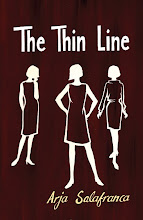
Review of The Thin Line
Real people have complex lives. The ones who, from the
outside, look as though they are enjoying idyllic stress-free existences are
often the sources of the most conflict. It takes work to look fine all the
time. That’s often why love is such a respite – it’s an opportunity to relax
the guard we construct for others. To breathe above the water, if only for a
moment. But, it is reckless to believe in stability, always.
The Thin Line, a collection of short stories from
South African writer Arja Salafranca, provides snapshots into the
lives of real, flawed humans. Short stories seem to place more pressure on a
sentence, and Salafranca’s prose is tight. Many of her descriptions had me
nodding jealously, aptly capturing some characteristic of South Africanisms.
That is because these short stories are not only
about people, but also reflect the changing context and themes of South African
middle-class existence. The theme of crime, emigration, the fear of violence
travel through many of the stories, revealing the characters through their
reactions to these themes. Her devices are slick and impressive.
First published here
Monday, May 25, 2015
Three Seasons by Mike Robbins
![]() |
| Three novellas about life in the 1980s |
Three
Seasons is an accomplished, highly readable collection of
three novellas by a writer whose a master of the novella – that “almost” Cinderella
of the literary world. Subtitled Three
Stories of England in the Eighties, all are connected only by being set in
three seasons, spring, summer and autumn.
I love reading novellas – longer than short stories,
shorter than novels, yet long enough to be immersed in a world that is slightly
simpler than that of the more convoluted novel.
And these were engaging indeed.
In the first, Spring,
a middle-aged Hull trawler skipper, sixtysomething Skip has one last chance to
make it big. Kevin, an eager young working class teen joins the crew on the
boat that early morning, oozing enthusiasm and eagerness. And then there’s the
young twenty-two old reporter, Katherine, reporting on the events of the
fishing village. How each story edges alongside the other is part of the beauty
of this piece filled with fishing and trawler detail, the vessel bobbing on the
cold seas. But there’s a disaster at the heart of this story, and Robbins’
skilled hand leads us onward, breathlessly to its inevitable conclusion.
In the second, Summer,
we’re in the heart of the booming merciless 1980s. Terry strides into the
story, ambitious, adulterous, his eye on the booming Thames Valley property
market. Terry was the least likeable or sympathetic of the characters, but
nevertheless holds interest despite his bravado and arrogance. In a story that
epitomises the worst of eighties greed and immorality, the story ranges across
a weekend, while its roots stretch back ten years. An allegory for a decade
long gone, yet immorality can never be confined to a single time.
The last, Autumn, is a
mediative piece that centres on the Master of an Oxford College, Makepeace. Long
married to Christine, he’s settled into a rigid severity: “Makepeace’s face was
lined and rather severe, the eyes themselves of mid-blue, the hair wiry,
strong, grey now of course, but complete and slightly curled.”
His two grown-up and very
different sons are coming home for a viist Tim, home from working abroad in Africa
and the Amazon, and James, arriving with his new wife of two weeks. Still living
at home is their impressionable teen daughter, Liz. The story takes place over
the night and morning of the sons’ visit, playing out against each of their
histories, roving from Makepeace to Tim to James to the new wife, Tamsin with
the exotic aura of being an actress about her. The story loops into the past,
shedding light on how the man grew into his and how the past has the ability to
not only to erode with its corrosiveness, but also how memory helps us to heal,
to bend. How it is possible to release the pain of the past and ultimately
learn to forgive and learn new ways of being and relating.
Subscribe to:
Posts (Atom)