The “Women’s Words: African Worlds” think-fest was a sensational idea, one with the potential to be a real opportunity for women writers from South Africa, Africa and the Diaspora in this, the African Union’s recently declared Decade of Women.
The sub-title, “renewing a dialogue between African women writers and women of African descent”, was bolstered by a line-up of substantial talent: elders Miriam Tlali and Lauretta Ngcobo, leading activists Elinor Sisulu and Zubeida Jaffer, academic Veronique Tadjo, as well as journalists, Maureen Isaacson, Gail Smith, Nokuthula Mazibuko and Arja Salafranca, and BOOK SA regulars Zukiswa Wanner and Henrietta Rose-Innes. These were coupled with a stellar guest-list of writers from abroad that included 2010 Commonwealth Writers Prize winner Adaobi Tricia Nwaubani. It promised to be a propitious space for the vital reconnection and reclamation of women’s voices on the Continent....read more here
Wednesday, September 8, 2010

Wednesday, September 1, 2010
Do we still need a Women's Day in 2010?
Why do women have a special day? This is the disgruntled question I’ve heard through the years.The usual retort is that men have 364 days – why not have one day for women?
But, I wonder if we still need a Women’s Day in 2010? Do women’s issues then conveniently get set aside because we’ve already celebrated and discussed women’s issues, so let’s now move on?
My women’s month started when I read poetry with a group of other women at the Jozi Book Fair on August 9.Women of all persuasions stepped upto the forum to declaim on a range of issues – from being single to hymns to grandmothers. I then found myself as part of the celebrations for the launch of a book by women writers only. Asked why there was a need for women-only publishers, I suggested that if men felt the need, why not put together a book of stories by men on the same topic?
But the point remains that men are perhaps starting to feel excluded.We may argue that women have just one day a year, but men’s issues – and they too deserve serious consideration – aren’t often on the agenda either. At the writers’symposium hosted by the Department of Arts and Culture, I was on a panel with the novelist Adaobi Nwaubani. She brought upthe point that women novelists were experiencing aflowering and being published, but was there not a danger of excluding men, or of men feeling excluded?Such a comment might provoke howls of outrage from women – and some men. But are we shooting ourselves in the foot with Women’s Day? Surely weshould place women’s issues firmly on the agenda,whatever the month, whatever the day?
I write, and live, from a position of relative privilege– although the finances of a single mother precluded me from private school, I still attended a government school that was highly regarded. I’vemoved through my working life without encountering a barage of sexism, although I’ve certainly brushedagainst sexist practices.
I’m lucky in that I entered the workforce in 1994,the year of democracy and change.When I started my first job as a community reporter, the editor was male, smoking was allowed and it was only the women reporters who wrote on the Womens League.When I left a few years later the editor was female, smoking had been relegated to the balconyand we all attended Womens’League meetings.
I have always felt myself to be valued by everyone with whom I have worked. Perhaps the tide has turned and we are now blessed to be working with men who have been enlightened by the fires feminism ignited.And my feeling is that we need to recognise this within men themselves. Although I welcome the attention afforded women during thismonth, I also lament that since we have a month to ourselves, so to speak, we don’t yet have the year.
(Published in The Sunday Independent, August 29)
But, I wonder if we still need a Women’s Day in 2010? Do women’s issues then conveniently get set aside because we’ve already celebrated and discussed women’s issues, so let’s now move on?
My women’s month started when I read poetry with a group of other women at the Jozi Book Fair on August 9.Women of all persuasions stepped upto the forum to declaim on a range of issues – from being single to hymns to grandmothers. I then found myself as part of the celebrations for the launch of a book by women writers only. Asked why there was a need for women-only publishers, I suggested that if men felt the need, why not put together a book of stories by men on the same topic?
But the point remains that men are perhaps starting to feel excluded.We may argue that women have just one day a year, but men’s issues – and they too deserve serious consideration – aren’t often on the agenda either. At the writers’symposium hosted by the Department of Arts and Culture, I was on a panel with the novelist Adaobi Nwaubani. She brought upthe point that women novelists were experiencing aflowering and being published, but was there not a danger of excluding men, or of men feeling excluded?Such a comment might provoke howls of outrage from women – and some men. But are we shooting ourselves in the foot with Women’s Day? Surely weshould place women’s issues firmly on the agenda,whatever the month, whatever the day?
I write, and live, from a position of relative privilege– although the finances of a single mother precluded me from private school, I still attended a government school that was highly regarded. I’vemoved through my working life without encountering a barage of sexism, although I’ve certainly brushedagainst sexist practices.
I’m lucky in that I entered the workforce in 1994,the year of democracy and change.When I started my first job as a community reporter, the editor was male, smoking was allowed and it was only the women reporters who wrote on the Womens League.When I left a few years later the editor was female, smoking had been relegated to the balconyand we all attended Womens’League meetings.
I have always felt myself to be valued by everyone with whom I have worked. Perhaps the tide has turned and we are now blessed to be working with men who have been enlightened by the fires feminism ignited.And my feeling is that we need to recognise this within men themselves. Although I welcome the attention afforded women during thismonth, I also lament that since we have a month to ourselves, so to speak, we don’t yet have the year.
(Published in The Sunday Independent, August 29)
Tuesday, August 24, 2010
African women writers 'renewing dialogue in own words'
by Edward Tsumele
Leading writers from South Africa, the rest of the continent and the diaspora are meeting at a women's symposium, called Women's Voices Unite, in Johannesburg tomorrow.
The symposium, sponsored by the Department of Arts and Culture, will be opened by Arts and Culture Minister Lulu Xingwana.
Some of the writers who have confirmed their participation include the award-winning jazz poet Jayne Cortez, Lola Soyinka - poet and novelist (married to novelist and literary critic Wole Soyinka's son ), another Nigerian writer, Adaobi Tricia Nwaubani, and Tsitsi Dangarebga from Zimbabwe.
They will share the stage with South African writers who include Miriam Tlali, Fiona Lloyd, Margaret Busby Obe, Lauretta Ngcobo, Henrietta Rose-Innes, Karabo Kgomotso Kgoleng, Luli Callinicos, Arja Salafranca and Masechaba Moshoeshoe.
The theme of the symposium is "Women's words: African worlds: Renewing a dialogue between African women writers and women of African descent".
It is hosted by the department in association with the Windybrow Theatre now also known as the Pan-African Centre for the Arts.
Lisa Combrinck, spokesperson for the department, says that this "think-fest is an African indaba" that will bring together women from South Africa with their sisters from the wider continent.
Some writers come from Ivory Coast, Algeria, Nigeria, and the African diaspora.
She said they hoped to strengthen women's voices through networks.
They will also prepare for the 2010-2020 African Decade for Women, initiated by the African Union.
"Theatre and poetry will also feature prominently in the programme. This is because with writing, debating and singing, in addition to our daily chores, we become fully women," Combrinck said.
Published in The Sowetan, August 24, 2010
Leading writers from South Africa, the rest of the continent and the diaspora are meeting at a women's symposium, called Women's Voices Unite, in Johannesburg tomorrow.
The symposium, sponsored by the Department of Arts and Culture, will be opened by Arts and Culture Minister Lulu Xingwana.
Some of the writers who have confirmed their participation include the award-winning jazz poet Jayne Cortez, Lola Soyinka - poet and novelist (married to novelist and literary critic Wole Soyinka's son ), another Nigerian writer, Adaobi Tricia Nwaubani, and Tsitsi Dangarebga from Zimbabwe.
They will share the stage with South African writers who include Miriam Tlali, Fiona Lloyd, Margaret Busby Obe, Lauretta Ngcobo, Henrietta Rose-Innes, Karabo Kgomotso Kgoleng, Luli Callinicos, Arja Salafranca and Masechaba Moshoeshoe.
The theme of the symposium is "Women's words: African worlds: Renewing a dialogue between African women writers and women of African descent".
It is hosted by the department in association with the Windybrow Theatre now also known as the Pan-African Centre for the Arts.
Lisa Combrinck, spokesperson for the department, says that this "think-fest is an African indaba" that will bring together women from South Africa with their sisters from the wider continent.
Some writers come from Ivory Coast, Algeria, Nigeria, and the African diaspora.
She said they hoped to strengthen women's voices through networks.
They will also prepare for the 2010-2020 African Decade for Women, initiated by the African Union.
"Theatre and poetry will also feature prominently in the programme. This is because with writing, debating and singing, in addition to our daily chores, we become fully women," Combrinck said.
Published in The Sowetan, August 24, 2010

Sunday, August 15, 2010

At the Johannesburg launch of the Bed Book of Short Stories at Love Books, Melville
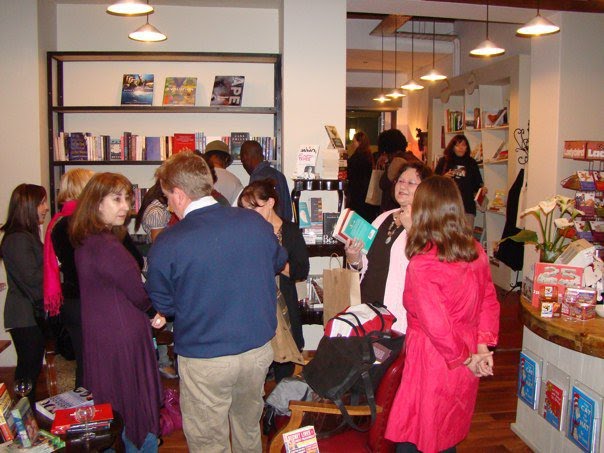 At the Johannesburg launch of Modjaji Book's The Bed Book of Short Stories at Love Books in Melville, chatting to Hamilton Wende
  Rita Britz, Arja Salafranca, unknown, Jayne Bauling, Lauri Kubuitsile, Isabella Morris
 Arja Salafranca, Isabella Morris and Lauri Kubuitsile
  Isabella Morris, Jayne Bauling (with microphone), Arja Salafranca
 Monday, August 2, 2010


Sunday, August 1, 2010
At the Cape Town Book Fair 2010
 Asking a question at a discussion on South African chick-lit at the 2010 Cape Town Book Fair.
Photo: Maire Fisher
Subscribe to:
Posts (Atom)


.jpg)

