Showing posts with label Modjaji Books. Show all posts

Tuesday, October 1, 2019


Coming soon! Fool's Gold, a selection of Modjaji short fiction published over the years.

Tuesday, April 9, 2019

Reg Rumney reviews Beyond Touch


I can think of no greater compliment to a poet than to say that you have read all the poems in a volume. Often, I dip into poetry books, reading some poems that look promising, or which particularly resonate, and pass over the rest. I read all of the poems in ‘Beyond Touch’ by Arja Salafranca.


Read more ...

Sunday, June 7, 2015

Invite to the launch of Beyond Touch, the new poetry collection of Arja Salafranca


Beyond Touch, a new poetry collection by Arja Salafranca


Arja Salafranca's third poetry collection, Beyond Touch, published by Modjaji Books and Dye Hard Press, June 2015. 

Review of The Thin Line

Real people have complex lives. The ones who, from the outside, look as though they are enjoying idyllic stress-free existences are often the sources of the most conflict. It takes work to look fine all the time. That’s often why love is such a respite – it’s an opportunity to relax the guard we construct for others. To breathe above the water, if only for a moment. But, it is reckless to believe in stability, always.

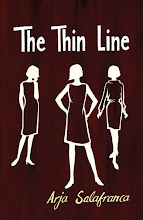
The Thin Line, a collection of short stories from South African writer Arja Salafranca, provides snapshots into the lives of real, flawed humans. Short stories seem to place more pressure on a sentence, and Salafranca’s prose is tight. Many of her descriptions had me nodding jealously, aptly capturing some characteristic of South Africanisms.

That is because these short stories are not only about people, but also reflect the changing context and themes of South African middle-class existence. The theme of crime, emigration, the fear of violence travel through many of the stories, revealing the characters through their reactions to these themes. Her devices are slick and impressive.

This collection is well-worth a read, especially for anyone who wants to write short fiction. I definitely learned a lot from her use of style and descriptions.

First published here

Sunday, May 3, 2015

PEN SA’s Q&A with Arja Salafranca

Favourite South African novel / poem?
I don’t have a particular favourite South African poem or novel and that does change with every new book read – but I do enjoy novels by South African novelists such as Damon Galgut and Ingrid Winterbach, for instance. I’m looking very forward to reading Craig Higginson’s just published The Dream House, andFinuala Dowling’s The Fetch... Read more.

Thursday, July 12, 2012

The Thin Line is long-listed for the 2012 Wole Soyinka Prize for Literature in Africa


The Lumina Foundation has released the long list for the 2012 Wole Soyinka Prize for Literature in Africa, and Arja Salafranca's short fiction collection, The Thin Line, has been nominated.
The short list will be announced in August. Read more here

Tuesday, June 19, 2012

The Edge of Things and The Thin Line on display at the Cape Town Book Fair 2012


The Edge of Things: South African Short Fiction, was published by Dye Hard Press in 2011 and The Thin Line was published by Modjaji Books in 2010. 

Tuesday, November 8, 2011

The Thin Line - Dividing line in human behaviour

A review of The Thin Line, by Dries Blunt 
This book combines excellent writing skill, an interesting choice of subject and a fine display of characters that become alive while reading. 
It also carries a message of love lost and gained and how fragile relations can be. 

At times I read this compilation of short stories as a number of real-life case studies which, in novel writing style, indicates the best possible portrayal of fictional reality.
There are 17 stories in which the thin line between lust and love, fulfillment and destruction and attraction are highlighted. 
Salafranca shows amazing insight in the psychological motivation of behaviour.  
The Thin Line is a collection with great impact, both delightful to read and valuable to have read.  
(Published in The Citizen)  

Sunday, September 4, 2011

Women writing for women during Women's Month

I’ve read two enormously different, but equally moving books in the past weeks – both of which reflect and affirm what I wish for women this month, and in particular women writers. The first was Reclaiming the L-Word: Sappho’s Daughters Out in Africa, edited by Alleyn Diesel (Modjaji Books 2011) and the second was Julia Cameron’s autobiography, Floor Sample: A Creative Memoir (Cameron of The Artist’s Way fame).

The same week I was reading Reclaiming the L-Word I was also reviewing Out in Africa films and documentaries for the Life section of The Sunday Independent...Read more here 

Thursday, August 25, 2011

The Thin Line on Peony Moon

The stories in The Thin Line hook the reader from the first one, and reel you in on that thin line. You will be haunted by the carefully drawn characters: by Corinna trapped in her huge teenage body, by Cleo in love with a married man after all these years, and poor skinny Mark, as he sees his lover teeter away from him. Salafranca is an accomplished, award-winning writer, this long-awaited collection is a box of jewels.

“These stories chart a new direction in South African fiction, where each line, each page – each story unfolds subtly, reaching deeper and more intimately into the tender spaces that exist in all our lives between love and doubt. Reading them kept me up late at night, wanting to know more about the characters’ lives. I was enthralled by the clarity and compassion of her insights; and moved by her obvious love for our fragile country and the fierce power of our unrelinquished hopes.” – Hamilton Wende

Read more here

Sunday, April 10, 2011

Review of Kerry Hammerton's These Are The Lies i Told You

This debut collection of poetry by Kerry Hammerton is a bumper one, numbering just under 60 poems – an impressive number, and more than the average length of a poetry collection.

I like that, though. I like the fact that I felt I could truly enter into Hammerton’s world through the sheer volume of work here.

It’s a particular world, told in a particular voice – a sharp, fun, sassy voice...Read more here

Thursday, December 23, 2010

Review of The Thin Line - Joan Hambidge in Die Burger


The Thin Line is ’n versameling kortverhale wat ’n mens eenvoudig nie kan neersit nie.
Arja Salafranca ondersoek die subtiele verbintenisse tussen mense, soos vroue wat saam koffiedrink, maar mekaar sonder woorde kritiseer, of, met giftige uitinge aanval; eks­geliefdes wat saamreis en in ’n vreemde landskap ontdek die verhouding werk nie meer nie, en sal nooit weer werk nie; ’n “verhouding” tussen twee mense wat liefdeloos is en tog uitloop op ’n desperate seksuele verkenning; ’n vrou wat haar manlike geliefde se eks-meisie seksueel begeer, najaag en ’n slot wat uitloop op ellende; ’n ondersoek na vetsug met ’n jong meisie wat haarself letterlik doodeet as die subteks . . Read more here

Monday, November 1, 2010

Writing in pictures brings daily life into crisp focus - Tanya Farber

Local award-winning writer Arja Salafranca has been brewing a collection of short stories over the years, and recently it came together in its collected form as The Thin Line. Luckily for the reader, not an ounce of pretentiousness got thrown into the pot along the way, and the result is a subtle yet gently haunting literary experience.

Salafranca's style in this collection is best described as cinematic. Each story plays out like a camera lingering on minutiae which, brought together, tell the reader a great deal about the characters and situations which form the subject matter.

"The earliest story was written when I was 18," she says, "and though I have written and published a number of short stories since then, there has been a lot of culling and pruning of my material."

The most striking - and refreshing - aspect of this collection is that it bears no trace of the albatross that many South African writers find tethered to their neck: the burden of our past, the issue of "representation", and the pitfalls of stereotyping and political correctness.

Salafranca casts all that aside in favour of an unashamed microcosmos of experiences. There is no attempt to be "definitively" South African.

"As a short story writer, I don't have a responsibility to show how awful society is or can be," she says. "But if someone changes how they think for having read it, then that is simply the beauty of writing."

She says local writers should never tell themselves that they need to send out a message. The mission, instead, is to move someone.

"If politics or a comment on society or the law comes into my stories, it is by the way," she explains.

And that is precisely why the collection makes for such thought-provoking reading: one is able to delve into the subtle detail of atmosphere, character and feeling without being bashed over the head with didactics.

Even in a story such as "A Car is a Weapon", Salafranca deals with the issue of fake drivers' licences, but at the heart of the story is the characters and the moral dilemmas that are thrown up, and Salafranca avoids lacing the text with her own opinion on the issue.

In terms of the process of her writing, she is often inspired by a photograph or an image in her mind. From there, the story develops a life of its own.

"When I start writing a story, I have an image in my mind. I usually know how it's going to end, but not how I'm going to get there."

Judging from the nature of each story, it appears that that image in her mind is usually the main character in clear focus, with a blurred background which slowly comes into sharp focus itself as the plot moves forward.

"The characters come through the story but it's not a conscious thing," she says.

In A Man Sits in a Johannesburg Park, for example, the story opens with a cinematic description of a man and his dog: "A man sits in a Johannesburg park on a late summer's afternoon. He releases the lead attached to his spaniel's collar and she bounds off to sniff trees and play near the river, perhaps the dog will even go for a swim again."

From here, the story gently rolls open to reveal a dilemma about emigration, and as this happens, the image of the man on the park bench acquires more meaning.This story, as well as the others, depict what Salafranca describes as the way in which we experience other people in our daily lives.

"You arrive in someone's daily life as you meet them for coffee, for example," she says, "and then after an hour or two you are apart and encountering someone else. You don't first come across their background information. You meet them during a slice of your life and it is a slice of their life too."

In terms of the publishing process, she says it is challenging for an unknown writer to get a collection of short stories published as there is "an assumption that you should get your novel out first".

But, she says, when booksellers say that short stories do not sell, the downfall is in the marketing.

"We have to throw short stories at the public the way we threw South African literature at the public a short while back. We were shown how great it was to read about ourselves."

She says she has heard it takes most people approximately three weeks to finish a book.

"Why not spend those three weeks with a short story book?" she asks, adding that in our busy lives, there is the advantage of dipping in and out of different stories.

If you agree with that philosophy, or are tempted to do so, The Thin Line is an essential read.

Published in The Star and Pretoria News, October 28 2010.

Sunday, August 15, 2010

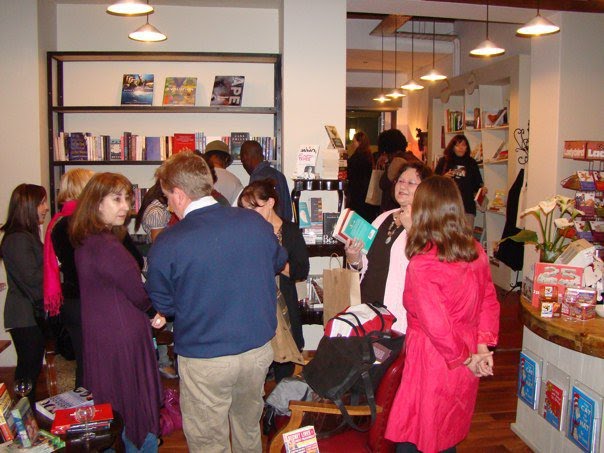
At the Johannesburg launch of the Bed Book of Short Stories at Love Books, Melville

At the Johannesburg launch of Modjaji Book's The Bed Book of Short Stories at Love Books in Melville, chatting to Hamilton Wende 

Rita Britz, Arja Salafranca, unknown, Jayne Bauling, Lauri Kubuitsile, Isabella Morris

Arja Salafranca, Isabella Morris and Lauri Kubuitsile

Isabella Morris, Jayne Bauling (with microphone), Arja Salafranca