Arja Salafranca talks about writing on SABC's breakfast show Expresso on Tuesday, 20 October 2015.
Wednesday, October 21, 2015
How to Write a Book in 30 Days
Arja Salafranca talks about writing on SABC's breakfast show Expresso on Tuesday, 20 October 2015.


Sunday, June 7, 2015

Beyond Touch, a new poetry collection by Arja Salafranca

Arja Salafranca's third poetry collection, Beyond Touch, published by Modjaji Books and Dye Hard Press, June 2015.
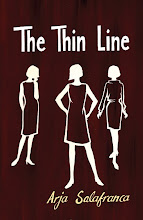
Review of The Thin Line

The Thin Line, a collection of short stories from
South African writer Arja Salafranca, provides snapshots into the
lives of real, flawed humans. Short stories seem to place more pressure on a
sentence, and Salafranca’s prose is tight. Many of her descriptions had me
nodding jealously, aptly capturing some characteristic of South Africanisms.
That is because these short stories are not only
about people, but also reflect the changing context and themes of South African
middle-class existence. The theme of crime, emigration, the fear of violence
travel through many of the stories, revealing the characters through their
reactions to these themes. Her devices are slick and impressive.
First published here
Monday, May 25, 2015
Three Seasons by Mike Robbins
 |
| Three novellas about life in the 1980s |
Three
Seasons is an accomplished, highly readable collection of
three novellas by a writer whose a master of the novella – that “almost” Cinderella
of the literary world. Subtitled Three
Stories of England in the Eighties, all are connected only by being set in
three seasons, spring, summer and autumn.
I love reading novellas – longer than short stories,
shorter than novels, yet long enough to be immersed in a world that is slightly
simpler than that of the more convoluted novel.
And these were engaging indeed.
In the first, Spring,
a middle-aged Hull trawler skipper, sixtysomething Skip has one last chance to
make it big. Kevin, an eager young working class teen joins the crew on the
boat that early morning, oozing enthusiasm and eagerness. And then there’s the
young twenty-two old reporter, Katherine, reporting on the events of the
fishing village. How each story edges alongside the other is part of the beauty
of this piece filled with fishing and trawler detail, the vessel bobbing on the
cold seas. But there’s a disaster at the heart of this story, and Robbins’
skilled hand leads us onward, breathlessly to its inevitable conclusion.
In the second, Summer,
we’re in the heart of the booming merciless 1980s. Terry strides into the
story, ambitious, adulterous, his eye on the booming Thames Valley property
market. Terry was the least likeable or sympathetic of the characters, but
nevertheless holds interest despite his bravado and arrogance. In a story that
epitomises the worst of eighties greed and immorality, the story ranges across
a weekend, while its roots stretch back ten years. An allegory for a decade
long gone, yet immorality can never be confined to a single time.
The last, Autumn, is a
mediative piece that centres on the Master of an Oxford College, Makepeace. Long
married to Christine, he’s settled into a rigid severity: “Makepeace’s face was
lined and rather severe, the eyes themselves of mid-blue, the hair wiry,
strong, grey now of course, but complete and slightly curled.”
His two grown-up and very
different sons are coming home for a viist Tim, home from working abroad in Africa
and the Amazon, and James, arriving with his new wife of two weeks. Still living
at home is their impressionable teen daughter, Liz. The story takes place over
the night and morning of the sons’ visit, playing out against each of their
histories, roving from Makepeace to Tim to James to the new wife, Tamsin with
the exotic aura of being an actress about her. The story loops into the past,
shedding light on how the man grew into his and how the past has the ability to
not only to erode with its corrosiveness, but also how memory helps us to heal,
to bend. How it is possible to release the pain of the past and ultimately
learn to forgive and learn new ways of being and relating.
Salad Anniversary by Machi Tawara
 Machi Tawara's first book of fifteen
poems, Salad Anniversary was first published in
1987 in Japan where, remarkably for a poetry book, it sold over two million
copies. In this slim, but delightful volume, she combines the classical ‘tanka’
Japanese form of short poetry, consisting of 30 tone syllables in a 5-7-5-7-7
pattern) to document a doomed love affair.
Machi Tawara's first book of fifteen
poems, Salad Anniversary was first published in
1987 in Japan where, remarkably for a poetry book, it sold over two million
copies. In this slim, but delightful volume, she combines the classical ‘tanka’
Japanese form of short poetry, consisting of 30 tone syllables in a 5-7-5-7-7
pattern) to document a doomed love affair.
The
poetry is sensuously beautiful, yet pared down, the language deceptively
simple, yet talking in unsentimental tones about the beginning and the ending
of love.
In
August Morning the narrator is with her lover: “You and I on a night beach face to
face in silence – a sparkler softy sputters. /Breaking your hesitation, I watch
you hunt for words to break the silence/Your left hand/exploring my fingers one
by one – maybe this is love.” Or is it? Later on in the same poem, the narrator
says simply: “Now that I wait for you no more, sunny Saturdays and rainy
Tuesdays are all the same to me.”
Longing suffuses these poems, moments are
briefly captured as in the title poem Salad Anniversary: “Folding towels,/I wrap the
smell of the sun – /perhaps one day I too shall be a mother.”
The
love affair continues in Baseball Game, but the signs are there: “You
have your future, I mine, and so we take no snapshots”, and later in the same
poem, “Cooking an omelette/flavoured with tears/of coming morning and farewell.”
This
achingly beautiful set of poems is accompanied by an afterward by the translator
Juliet Winters Carpenter. Highly recommended.
.
A Wilder Rose by Susan Wittig Albert
 |
| A Wilder Rose is the story of the Little House books and the possible literary deception behind them |
This extremely readable
novel tells the story of Rose Wilder Lane, daughter of Laura Ingalls Wilder,
author of The Little House books (Little House on the Prairie and others in the
series). Or was Laura really the sole and accomplished author of the books?
Lane was already a
successful popular writer when she returned to her parents’ Ozark farm in Rocky
Ridge in 1928. Divorced from a husband, she had also lived abroad and had rich experiences
behind her. She had a plump portfolio of investments behind her. There she
imagined she would both add to her portfolio as well as build her parents a
modern farmhouse wired with electricity and indoor plumbing. She was making
money with her writing – and her income was going through the stock market
roof. Life was good. She was accompanied by her friend Troub, with whom she had
a relationship – although this is somewhat opaquely referred to in this novel.
Writer Albert re-imagines
the events of these years. With a foreboding known to us through history only
we read as Lane and her companion experience the horrors of the stock market crash
of 1929. Lane finds herself stuck through circumstance and desperation on the
farm; finds her relationship with Troub withering away bewilderingly: “We had
prided ourselves on enjoying each other, without obligation. And now that we
reached the end, neither of us gave way to tears – not then, anyway.” Troub
would later go on to write children’s novels penning the Sue Barton and Carol
Page series.
And into this chasm her
mother, a pioneer girl, comes to her with a scrap of a story of her early
years. It’s poorly written, hardly publishable, hardly even a book, but Lane
sets out to fix the writing, and it’s eventually published with more books
promised. The literary deception, begun so innocuously and innocently, is in
full force. Her mother will be known as the author of the children’s books –
even though the truth is, it’s more of a collaboration between mother and
daughter. Or is it?
This is a novel of that
collaboration, although there is still some doubt as to the veracity of that claim, as well as of the complicated knot of the mother/daughter
relationship between Laura and her only child, a tie that Lane sometimes felt
like a stranglehold, and of how Lane shaped her mother’s story into publishable
books.
The world of 1930s
small-town America is also intricately recreated in this book – a time when
modern conveniences such as electricity and plumbing were still luxuries in
rural areas; and pioneer women could still remember the wagons and wildness
that permeated their youth. But it’s a
bleak time in history with the country decimated by the disaster and the great
dust storms. When Lane travels the country, writing a book on it, the harshness
edges through: “Dust, dirt, wind. ‘We know where the dust comes from by its
colours,’ one farmer’s wife told me, holding her apron across her face.”
But it is also a story of
Lane herself – little known now beyond the history books – and it’s a
fascinating story. A woman who lived by her own rules in a time when most women
married and subsumed themselves in that bond; a woman who took up her pen and
wrote her way to fortune and kept on writing even when that pile disappeared. A
woman who had been born in poverty, who managed to move beyond her life’s circumstances.
Lane is an spirited woman and one of the
treasures of this novel is how enormously likeable she is; with Wittig creating
an empathy that leads you through the book. Lane’s life is at times unrelentingly hard in
those years: trapped, failing dental health, growing older, her life moving
away from her. But I found myself compulsively reading to the end, drawn on,
entranced by this woman’s strength and vigour.
Sunday, May 10, 2015
The Peculiar State – single short story
 |
| Thought-provoking short story by South American writer Patricio Pron |
In this thought-provoking story, The Peculiar State by
South American, Patricio Pron, we’re
introduced to the world of a lapsed writer living in Homburg with his statistician girlfriend.
Unnamed, the protagonists are simply referred to as
he and she – which lends the story a bare, stripped down essence.
Although once a successful novelist, the muse
hasn't visited for some time and he spends his days as a “creative consultant”
answering questions on his first impressions of chocolate and other mundane
objects, trying to get as far away as possible from the problems of “the death
of the novel and the peculiar state of the short story”.
But the real meat of the story takes place when he
and his girlfriend go away to various foreign cities to play a game the
girlfriend has made up. They go to the same city – but travel separately, stay
in separate hotels – neither knows where the other is. The game consists in
finding each other in these European cities – deducing where each might go,
based on their own interests, and of course, knowledge of each other. In many
ways it’s a dangerous game – what if they don’t find each other in these places
and return home alone, having failed? The consequences would be serious: it
means they don’t know each other as well as they would have hoped – and what
does that, in turn, mean for their coupling?
“She remembers something he said to her one day,
maybe after the first or second they’d played their game: that the day they
can’t find each other is the day on which everything between them will be
over... She realises she’s about to cry because she feels herself capsizing
from within.”
The story is shot through cleverly with a number of
statistics – referencing the girlfriend’s interest in the subject – which also
has inspired the game. What are the probable statistics that they will find
themselves in such and such a city, for instance? This is a question with more
meaning than recounting such obvious facts as: “women cry an average of 5.3
times a month; men 1.4” or that he is
part of the 41 percent of the German population that hasn't read a single book
in the last three months.”
In this story the couple go away to Berlin –
searching for each other over the roughly a week they are there? But what
happens if they can’t find each other? Is the “losing game” as she’s thought of
dubbing it, a way back into their relationship, or a chilling arrow pointing
out something more sinister in their relations?
This short story throws up so many
questions and possibilities about the probabilities in our lives, the people
who are there in it, or not, and whether numbers on a page, those endless
statistics should really be used to measure our happiness and progress through
life.
This endlessly interesting and inventive short
story comes from Pron, one of Granta’s Best Young Spanish-Language Novelists and
the author of a debut novel, My Fathers’ Ghost Is Climbing in the
Rain, described as a daring and deeply affecting story
of one Argentine family’s buried secrets. When
a young writer returns home to visit his dying father, he finds himself drawn
into an obsessive search for a local man gone missing.
Subscribe to:
Posts (Atom)


.jpg)

