Showing posts with label Interviews with Arja Salafranca. Show all posts

Sunday, August 31, 2014

Adults Only teaser: Q&A with Arja Salafranca

Joanne Hichens – editor of the Adults Only, the second annual Short.Sharp.Stories Awards anthology – interviews Arja Salafranca.
Arja Salafranca has published two collections of poetry, A Life Stripped of Illusions, which received the Sanlam Award for poetry and The Fire in which we Burn; a third is forthcoming in 2014. Her debut collection of short fiction is titled The Thin Line, and long-listed for the Wole Soyinka Award in 2012. She has participated in a number of writers conferences, edited two anthologies of fiction and non-fiction, and has received awards for her poetry and fiction. She is the lifestyle and arts editor at The Sunday Independent. Find her online atarjasalafranca.blogspot.com.
So… a collection of sexy stories… what’s your take?
Sex is everywhere around us – seemingly – on television and billboards, online and elsewhere – and yet, you don’t find much of it in literary terms, it’s something only partially explored in SA writing – and so I think this volume will be a welcome addition to the literary canon.... Read more here

Monday, June 17, 2013

Short Story Day Africa 2013 - The Interview

Do you actually enjoy writing, or do you write because you like the finished product?

I love writing – I love the solitude, the silence and the zone you go into as you create other worlds, discover things about yourself, tell stories that are roaming around in you and need an out. I couldn’t live without writing.

What are you reading right now? And are you enjoying it? 
I’m reading The Journals of John Fowles, Vol 1. I am enjoying – although reading journals means you plunge directly into someone’s world and psyche and it can be dark there at times – you need to come up for breathe from time to time. But I love reading about John Fowles’s tempestuous and confusing love life and can relate to his need to write, yet earn a living and not having enough time to do that precious writing.  Waiting in the wings is a book of travel essays on Antarctica – I’m somehow drawn to that cold, clean, austere place.

Have you ever killed off a character and regretted it?
No I haven’t, they were meant to go, if they got killed. But I did regret saying goodbye to Alexia in my novella Triangle – we’d been together three years in the writing, and it was a wrench saying goodbye.

If you could have any of your characters over for dinner, which would it be and why?
In one of my short stories, ‘Desire, with Borders’, I actually had me as the writer going to a coffee shop where some of my characters were having meals. But none of them recognised me! They weren't even interested in meeting me – so no I don’t think it would be a good idea to have any of them to dinner. Besides I don’t know their addresses ....

Which one of your characters would you never invite into your home and why?
Perhaps Tyra, she murdered her lover out of jealousy and then took on her personality, or Rivka the 18th century midwife who caused damage to a baby – oy, can’t believe I created them or that they come from me!

Ernest Hemingway said: write drunk, edit sober. For or against?
Sober! I hardly ever drink, I’m quite allergic to wine, sadly.

If against, are you for any other mind-altering drug?
No not really. When you’re writing well you’re high enough, you don’t need anything extra IMHO

Our adult competition theme is Feast, Famine and Potluck. Have you ever put food in your fiction? If so, what part did it play in the story?
 Yes there’s food in my stories, my poems, my everything. I wrote a story, ‘At the table of the short story’ in which I examined women’s attitudes to food, weight, diet and so on. Lots of characters talking about that.

What’s the most annoying question anyone’s ever asked you in an interview?
What are your themes? 

If you could be any author other than yourself, who would you be?
Anyone rich and/or making a living from writing – I could get up at 10 every morning and amble off to my study when I am finally awake and dream the day into existence.

If you could go back in time and erase one thing you had written from your writing history, what would it be and why?
 I think it all exists for a reason – although there are poems that are weaker than others, or stories, they all mean and meant something. So I’d keep everything, good, bad and indifferent.

What’s the most blatant lie you’ve ever told?
I don’t like lying, really, but now and again you tell a white lie to protect others and yourself, I think they are necessary. 

If someone reviews you badly, do you write them into your next book/story and kill them?
Nah, I stew and simmer and think they’re oh so stupid for not getting it, then I put on my adult hat and attempt to be philosophical. Notice the word: attempt. 

What’s your favourite bad reviewer revenge fantasy?
They write a book and it in turns gets reviewed badly! 

What’s the most frustrating thing about being a writer in Africa?
 Not having the luxury of many grants to apply to and fellowships – so that most of us have to toil at jobs when we should be home writing. Lack of time. 

Have you ever written naked?
NEVER! 

Does writing sex scenes make you blush?
At times yes – but they’re so often necessary. 

Who would play you in the film of your life?
Meryl Streep for sure! 

If you won the Caine Prize for African Fiction, what would you do with the money?
Take a few months off work, hole up n my study and just write, that would be the perfect way to spend the time and money. 

What do you consider your best piece of work to date?
The novellas I finished for my MA – as they’re the most recent of my fiction. 

What are you doing on 21 June 2013, to celebrate Short Story Day Africa?
I’m on leave so I’ll be home, writing – after getting up at 10am!


Friday, November 4, 2011

Voila! chatroom: an interview with Arja Salafranca, by Nikki Temkin


Arja Salafranca selected the short stories for The Edge of Things, a compilation of South African short stories. I chatted to her.

NIKKI:  What were the criteria for selection forThe Edge of Things?
ARJA: Firstly, a story had to move and touch me, make me feel something, reflect on some aspects of life and our experiences here. Secondly, I was looking at excellence in terms of telling a story, well-crafted stories that begin with something deep inside and move readers because these were tales that just had to be told.

N: What was the inspiration for this book?
A: The book was initially meant to be an edition of the literary journal, Green Dragon. I received nearly 100 submissions and then selected the 24 stories that make up the anthology. It was too large for a journal, so I suggested that it become a special short fiction edition. I decided to do it because of my own love of the short story – as both a short story writer and as a prodigious reader of the genre.

N: Can you tell us about some of the themes of the book?
A: Some of the stories centre on solitude – and the ramifications of that, from loneliness, to a sense of fulfilment that also results from time spent alone, some centre on relationships experienced, some are about the outsider from society. Some of the stories explore the mother-daughter bond, some look at childhood experiences, some reach deep into South Africa’s past, looking at how those experiences have shaped those in the stories. Others look at identity issues in post-apartheid South Africa, and my own story deals with polio and the mother-daughter bond.

N: What do you think of South African writing currently?
A: It’s extremely vibrant and healthy – certainly in terms of the volume of fiction being produced, and we have some world-class writers, both established as well as emerging. South Africans are now so much more receptive to reading local literature – and there’s also such a range – from literary, to science fiction to crime thrillers and more.

N: Who are some of your favourite local authors?
A: I love Damon Galgut’s fierce, spare, almost uncompromising vision; David Medalie’s collection of short stories The Mistress’s Dog as well as Henrietta Rose-Innes’s Homing. I also love the poetry of Eva Bezwoda Royston (sadly she committed suicide in the 1970s). It’s personal, confessional poetry full of rich, dark and vivid imagery.

(Published in Voila!, Issue Number 8, 2011) 

Friday, July 22, 2011

Podcast of Interview on Radio Today about The Edge of Things

Arja Salafranca was interviewed by Sue Grant-Marshall about the anthology of South African short fiction, The Edge of Things, on the Reading Matters programme for Radio Today on July 14th. 

You can listen to the podcast of the interview here.

Saturday, January 15, 2011

Forthcoming publication from Dye Hard Press: The Edge of Things

The Edge of Things is a special issue of Green Dragon, to be published by Dye Hard Press, and consists of 24 short stories selected by Arja Salafranca. The authors are Jayne Bauling, Arja Salafranca, Liesl Jobson, Gillian Schutte, Karina Magdalena Szczurek, Jenna Mervis, Jennifer Lean, Fred de Vries, Margie Orford, Aryan Kaganof, Bernard Levinson, Hamilton Wende, Pravasan Pillay, Beatrice Lakwana, Hans Pienaar, Rosemund Handler, Tiah Beautement, Angelina N Sithebe, Jeanne Hromnik, David wa Maahlamela, Perd Booysen, Gail Dendy, Silke Heiss and Dan Wylie.

Publication is scheduled for March 2011.
More details to follow.

Monday, November 1, 2010

Writing in pictures brings daily life into crisp focus - Tanya Farber

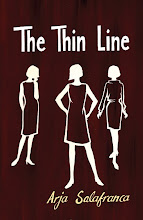
Local award-winning writer Arja Salafranca has been brewing a collection of short stories over the years, and recently it came together in its collected form as The Thin Line. Luckily for the reader, not an ounce of pretentiousness got thrown into the pot along the way, and the result is a subtle yet gently haunting literary experience.

Salafranca's style in this collection is best described as cinematic. Each story plays out like a camera lingering on minutiae which, brought together, tell the reader a great deal about the characters and situations which form the subject matter.

"The earliest story was written when I was 18," she says, "and though I have written and published a number of short stories since then, there has been a lot of culling and pruning of my material."

The most striking - and refreshing - aspect of this collection is that it bears no trace of the albatross that many South African writers find tethered to their neck: the burden of our past, the issue of "representation", and the pitfalls of stereotyping and political correctness.

Salafranca casts all that aside in favour of an unashamed microcosmos of experiences. There is no attempt to be "definitively" South African.

"As a short story writer, I don't have a responsibility to show how awful society is or can be," she says. "But if someone changes how they think for having read it, then that is simply the beauty of writing."

She says local writers should never tell themselves that they need to send out a message. The mission, instead, is to move someone.

"If politics or a comment on society or the law comes into my stories, it is by the way," she explains.

And that is precisely why the collection makes for such thought-provoking reading: one is able to delve into the subtle detail of atmosphere, character and feeling without being bashed over the head with didactics.

Even in a story such as "A Car is a Weapon", Salafranca deals with the issue of fake drivers' licences, but at the heart of the story is the characters and the moral dilemmas that are thrown up, and Salafranca avoids lacing the text with her own opinion on the issue.

In terms of the process of her writing, she is often inspired by a photograph or an image in her mind. From there, the story develops a life of its own.

"When I start writing a story, I have an image in my mind. I usually know how it's going to end, but not how I'm going to get there."

Judging from the nature of each story, it appears that that image in her mind is usually the main character in clear focus, with a blurred background which slowly comes into sharp focus itself as the plot moves forward.

"The characters come through the story but it's not a conscious thing," she says.

In A Man Sits in a Johannesburg Park, for example, the story opens with a cinematic description of a man and his dog: "A man sits in a Johannesburg park on a late summer's afternoon. He releases the lead attached to his spaniel's collar and she bounds off to sniff trees and play near the river, perhaps the dog will even go for a swim again."

From here, the story gently rolls open to reveal a dilemma about emigration, and as this happens, the image of the man on the park bench acquires more meaning.This story, as well as the others, depict what Salafranca describes as the way in which we experience other people in our daily lives.

"You arrive in someone's daily life as you meet them for coffee, for example," she says, "and then after an hour or two you are apart and encountering someone else. You don't first come across their background information. You meet them during a slice of your life and it is a slice of their life too."

In terms of the publishing process, she says it is challenging for an unknown writer to get a collection of short stories published as there is "an assumption that you should get your novel out first".

But, she says, when booksellers say that short stories do not sell, the downfall is in the marketing.

"We have to throw short stories at the public the way we threw South African literature at the public a short while back. We were shown how great it was to read about ourselves."

She says she has heard it takes most people approximately three weeks to finish a book.

"Why not spend those three weeks with a short story book?" she asks, adding that in our busy lives, there is the advantage of dipping in and out of different stories.

If you agree with that philosophy, or are tempted to do so, The Thin Line is an essential read.

Published in The Star and Pretoria News, October 28 2010.

Saturday, July 17, 2010

Interview with Arja Salafranca at The Dye Hard Interviews

Dye Hard: Short fiction has been referred to as a sort of poor relation of the novel. What are your thoughts on that, and why do you prefer short fiction over the novel?

Arja Salafranca: I think short fiction is certainly the “poor relation” to the novel, but only in the way it is perceived by the majority of publishers, readers and booksellers. The majority, not all, otherwise we would have no collections by single authors out there at all! It’s been all a bit of a catch 22 – with stories not selling in significant volumes, publishers seem to have cut back on publishing collections by single authors in the last ten, fifteen years...Read more here

Wednesday, December 17, 2008

Profile on Arja Salafranca

by Janet van Eeden
(Published in The Witness September 2007)

Poetry Africa, organised by the Centre for Creative Arts, comes to Durban from the 1st to the 6th October, 2007. One South African who will be there is Arja Salafranca. She’s taking time out from her day job as Sunday Independent Arts Editor, and Editor of Sunday Life. After reading many of her haunting poems, I spoke to Salafranca about her poetry.

Although all poetry requires that a poet takes a distanced view of the world, the sense of Salafranca being an outside observer is quite profound. I wondered where this came from.

“I think it comes from both my natural personality as well as the circumstances of my birth and upbringing,” Salafranca answers. “I was born in Malaga to a Spanish father and a South African mother. She couldn't speak Spanish. When I was four we went to live in Israel. Again we were outsiders and battling to learn Hebrew. When I was five my mother left my father and returned to this country. Even though she was born here, everything had changed. In addition, my mother has always gone beyond the establishment. Although brought up Jewish, she had a child with a Catholic man. She instilled that same healthy disrespect for the establishment and tradition in me. So I was always looking at the world with questions, an outsider looking in.”

Salafranca’s poetry often takes a moment in history as its starting point. Poems such as Kissing the Wall and Nat Guntman’s Wife are snapshots of real events blown up to life size. Why is Salafranca drawn to moments which depict social phenomena?

“I am naturally more interested in the personal histories that are not documented in history books,” she answers. “I once saw a book about life in a village in France in the 1800s. The book was about their everyday life. I am far more interested in those experiences than whether Madonna can adopt again. I get drawn in by a photo or an image on television. I am interested in certain periods of history always spurred by images.”

Salafranca wouldn't consciously call herself a social commentator although she supposes that writers do comment on the world around them. “It's the nature of writing fiction and poetry.”

Some of Salafranca’s personal poems show the detached observer watching people making unwitting fools of themselves. This made me wonder whether personal poetry can serve as revenge at times.

“I suppose it can,” she answers, “although I haven't and don't use my poetry as revenge. But others, who are depicted in the poems or short stories, have sometimes felt that they want to tell their side of the story. Fair enough. They should do so. But they should also realise that once an incident makes its way into a poem or story it's no longer strictly true. A writer manipulates the truth, using life to produce art, so nothing is literal. I think personal poetry serves as more of a catharsis actually, and then once you've written about something, if it touches readers, it becomes more universal. Others can relate, take comfort or find their own sense of catharsis from it perhaps.”

Salafranca won the Sanlam prize for poetry when she was just twenty two, and later won the Sanlam prize for short stories when she was twenty seven. I asked her whether winning an award at such a young age felt like reaching her zenith very quickly.

“Yes it did feel like that,” Salafranca says. “I learnt, really quickly, that winning awards makes other writers jealous and sometimes unexpectedly malicious. I was warned about that by Tatamkhulu Afrika and boy was he right! But it always serves as an impetus. I feel spurred on to create more so for me it doesn't hinder the creative process. What hinders it is for me is moving around so often - I have just moved again - and of course coping with the demands of a full-time job. Would I be more creative if I was filthy rich and had all the time in the world? I'd like to think that I would take six months off, travel like mad, read countless books and then I would settle down and produce storms of copy. Who knows?”

Salafranca has written poetry since she was ten. “I don't know why I started. It seemed like an ‘easy’ medium - I hear the howls of outrage now!” she says. “And it remains an ‘easy’ medium for me. A poem is written quickly, and is revised quickly. You can distil an experience in a few lines. I do find writing easy, and I am a quick writer so the other forms of writing that I do are equally enjoyable: the short stories, the journalism and essays. But writing poetry is a magical process, so satisfying as long as I mix it with doing other writing. Poetry can be quite marginalized and people do think you live in the clouds if you say you're a poet. Maybe poets do, some of the time, but it's a better place to be than stuck in gritty traffic on William Nicol Drive at peak hour!”