Arja Salafranca talks about writing on SABC's breakfast show Expresso on Tuesday, 20 October 2015.
Showing posts with label Arja Salafranca. Show all posts
Showing posts with label Arja Salafranca. Show all posts
Wednesday, October 21, 2015
How to Write a Book in 30 Days
Arja Salafranca talks about writing on SABC's breakfast show Expresso on Tuesday, 20 October 2015.

Sunday, June 7, 2015

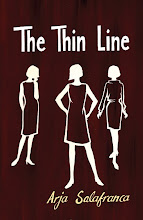
Review of The Thin Line

The Thin Line, a collection of short stories from
South African writer Arja Salafranca, provides snapshots into the
lives of real, flawed humans. Short stories seem to place more pressure on a
sentence, and Salafranca’s prose is tight. Many of her descriptions had me
nodding jealously, aptly capturing some characteristic of South Africanisms.
That is because these short stories are not only
about people, but also reflect the changing context and themes of South African
middle-class existence. The theme of crime, emigration, the fear of violence
travel through many of the stories, revealing the characters through their
reactions to these themes. Her devices are slick and impressive.
First published here
Sunday, May 3, 2015
PEN SA’s Q&A with Arja Salafranca
 Favourite South African novel / poem?
I don’t have a particular favourite South African poem or novel and that does change with every new book read – but I do enjoy novels by South African novelists such as Damon Galgut and Ingrid Winterbach, for instance. I’m looking very forward to reading Craig Higginson’s just published The Dream House, andFinuala Dowling’s The Fetch... Read more.
Sunday, August 31, 2014
Ruminations on love and writing: interview with Athol Fugard
 |
| Athol Fugard as Oupa in The Shadow of the Hummingbird |
“This is the smallest play I've
ever written, but it has generated more noise than the others. I never thought
it would impact on people the way it has,” says playwright Athol Fugard. It’s an early
weekday morning and I’m talking to him on the wide stoep of the guesthouse
where’s he staying while performing in The
Shadow of the Hummingbird at the Market Theatre. He’s smoking his pipe,
and the sweet smelling tobacco wafts my way as we talk, mostly about this new
play, and its genesis. His partner, and
collaborator on the play, Paula Fourie, sits close by, smoking.
At times, hadedas punctuate our
conversation through, flying noisily, screeching their
presence at us, a far cry from the quiet shadows and suggestions of the
hummingbirds which punctuate this latest play as motif throughout a gentle
telling.
On the surface, The Shadow of the
Hummingbird is a quiet play. At just an hour in length, it’s set in two parts.
The first part introduces us to an old man, a retired South African school teacher, Oupa, now
living in retirement in California, played by Fugard himself. He’s kept
notebooks for years – and is searching for a particular entry from among the
clutter of books and notebooks in his room.
These excerpts are from Fugard’s
actual unpublished notebooks – a habit he continues to maintain today. He
likens the habit to what Virginia Woolf said about “capturing the image on the
wing” and adds that keeping a notebook for writers is akin to the finger
exercises of a pianist: “Writers must put pen to paper, capture the flower
you’ve seen, the thought you’ve had. One of the questions I always ask young
writers is whether they keep a notebook.”
There’s something about a shadow
that Oupa is seeking, and he can’t find it. He goes through many entries, reading
fragments from each. There are lists of
bird sightings – Fugard himself is an avid bird-watcher – ruminations on death, on the
meaningless of the turning of the new year, a paean to Port Elizabeth, love, the
eager anticipation of having a grandchild, and the ever elusive search for the
entry with the shadow, shadow as metaphor for life itself, and then that the final reckoning.
 |
| Paula Fourie, Fugard’s partner and co-writer of The Shadow of the Hummingbird |
Fourie was responsible for writing
the first section. Fugard had written the play, but it was too short to be
performed, and it was decided that Fourie would edit and go through some of the
notebooks, and combine them into the text, with Oupa
reading the entries. Fourie worked through 20 years of unpublished books.
However, as she explains to me, the process was an alchemy in terms of
combining fiction and non-fictional elements. Oupa isn’t Fugard – so there were
some changes, such as not including the notebook entries on rehearsals for The Captain’s Tiger, for instance. Fugard
adds that this really is an example of the collaborative nature of theatre,
that theatre itself is a collaborative form.
Fugard explains that there were
two seminal images that served as the genesis of the play. When he was based in
California, he was writing and kept being alerted to the shadow of hummingbirds
flitting around the birdfeeder on the patio outside. “Every morning I watched
the shadow for a few minutes.” He also remembered “making an entry in my
notebooks in the early 1960s when I was writing The Blood Knot – the last entry I read on stage – the seed stayed with
me for days”.
Returning to the play, Oupa’s search
is interrupted by the arrival of his grandson, Boba (Marviantos
Baker) who instantly becomes part of a fun game the
two appear to have played for years with Boba slaying his grandfather, who is now a
teacher from the black lagoon! Fugard’s real grandson, Gavyn, served as the inspiration here for part of Boba.
This was another opportunity to
collaborate further, as Fugard notes. In the American version of the play,
which was staged prior to its South African run, the role of the grandson was
played by two 10-year-old twins alternating in the role – because of their
youth, they served more as foils to the role of Oupa. But Baker, although being
23, could look 13, and thus became an older grandson, “which took the play to a
new level, and opened up areas of the play, with Marviantos making his own contributions,” says Fugard.
On stage, this fun banter and play
turns to serious talk as watch the two navigate the realities of their
relationship – Oupa is estranged from his “stupid” son – and bonds with his
beloved grandson only through these secret meetings. The love between
grandfather and grandson is palpable and fierce.
 |
Athol Fugard takes the role of
Oupa alongside Marviantos Baker as
Boba, the grandson, in The Shadow of the Hummingbird |
This is a cerebral work – and in
this last section Oupa quotes an allegory of Plato’s to the boy, and then goes
through War and Peace, holding up the
book as a standard to this young child, who, in his youth, doesn’t always get
all the allusions and references Oupa wants to impart. This is also as much a
play about that bond as with the final reckoning and slow acceptance of what’s
inevitable, after a long life.
But it’s the thread of
love that runs through the play alongside the search for shadows that intrigues
and I want to ask about the line of love in the story. In one notebook entry we hear: “Living through another death
and once again I know that it is only through love that I will resurrect myself.”
The vicissitudes and habit of love continue to echo through the story, and then, towards the end, Oupa quotes from Tolstoy’s War and Peace: “What is ‘love’? he
thought. Love hinders death. Love is life. All, everything that I understand, I
understand only because I love. Everything is, everything exists. . .everything
that I understand, I understand only because I love.”
Fugard says, “Love is the only energy I’ve
ever used in writing – if I don’t love that individual on paper, it doesn’t
work." But it has presented wonderful challenges: “For example in Boesman and Lena, loving Lena, a victim
of a dark and complex relationship is easy, and yet with Boesman, the
character, I also fell in love with him, although that was a severe challenge.
And, in writing, I have to leave negative emotions outside the door, hate,
anger, jealousy, it leaves nothing on the paper.”
For the future, Fugard continues to leave a trail on paper.
There’s a new play due to be performed in March next year, and he has an idea
for a second novel, perhaps to be titled, Dry
Remains, the title taken from the five stages of decay the body goes
through after death, from fresh to bloat, active decay, advanced decay and
finally dry remains. “Maybe we can look
at a life in the same way,” he muses.
But for now, Fugard is treading the boards again – an acting
role he took on because, “I felt I could do a better job of Oupa than anyone
else.” He’s performed the role from the US to South Africa, and describes the
first performance in the US as “like being in a holding cell of the gallows.
But Oupa posses me so completely on stage. In a strange sense I know exactly
what I’m doing.”
“Perhaps,” says Fourie, “Oupa is a version of you, what you
could have become?” She’s referring to the fact that Fugard may have become a
teacher.
As he says goodbye and steps through the wooden doors of the
guesthouse, I remember the other phrases he used early on in referring to
himself, and the mix between him and character he plays. Eyes laughing he’d
said, “It’s me in my various disguises – as an old schoolteacher or you can
also call me Helen Martins in drag!” in an allusion to the play, A Road to Mecca. Or, another line he
used to refer to himself, eyes, twinkling, taking delight in the strange twist
of words of juxtaposition of thought: “A man who loves in strange and crooked
ways.”
Friday, June 22, 2012
Launch of Inheriting the Earth: Jill Nudelman Discusses Her Debut Novel

The
launch of Jill Nudelman’s Inheriting the Earth was
held on 18 June at The
Book Lounge in Cape Town. Adele Branch from UKZN Press welcomed the
audience and introduced Nudelman and Arja Salafranca, who joined her at the
launch to discuss the book.
The discussion started with Salafranca reading a précis of the
book which is about Rose, a girl who was orphaned at a young age and adopted.
She knows nothing about her biological family until her foster mother dies and
she inherits a fortune along with a box of artefacts that provide her with
clues to her ancestry... Read more here
Friday, April 13, 2012
All’s fair in love and war at the 2012 Franschhoek Literary Festival
The annual Franschhoek Literary Festival features an array of topics from hot politics to cool poetry, love stories to the horrors of war.
The festival takes place from 11 – 13 May.
Books are often the inspiration for movies, but in Rhumba, Michele Magwood talks to Elaine Proctor, a South African film-maker living in London, about the process of turning a film script into a novel about a boy’s search for his mother through an immigrant’s nightmare alleviated by friendship and redemption.
Happiness is a Four-Letter Word will have Arja Salafranca chatting to Cynthia Jele about the love story that won the 2011 Commonwealth Writer’s Prize Africa section.
Countless soldiers have fought and died in wars down the centuries. This year, several sessions at the FLF honour their sacrifices.
In 20th century wars, historians Bill Nasson and Mark Connelly will criss-cross the century from the Anglo-Boer conflict to the Falklands War. Angola’s long shadow will revisit the malignant scars of the Border War with Brent Meersman, Mark Behr, Johan Vlok Louw, photographer John Liebenberg and his co-author on Bush of Ghosts, Patricia Hayes. Mark Behr will also talk to James Whyle about The Book of War, set during the mid-19th century War of the Prophet in the Eastern Cape.
And there’s much, much more: eminent authors debating the direction of our country, some of SA’s top novelists, crime, satire and state secrets…
The full programme of the 2012 Franschhoek Literary Festival is online atwww.flf.co.za with bookings open on www.webtickets.co.za
Published at artslink
The festival takes place from 11 – 13 May.
Books are often the inspiration for movies, but in Rhumba, Michele Magwood talks to Elaine Proctor, a South African film-maker living in London, about the process of turning a film script into a novel about a boy’s search for his mother through an immigrant’s nightmare alleviated by friendship and redemption.
Happiness is a Four-Letter Word will have Arja Salafranca chatting to Cynthia Jele about the love story that won the 2011 Commonwealth Writer’s Prize Africa section.
Countless soldiers have fought and died in wars down the centuries. This year, several sessions at the FLF honour their sacrifices.
In 20th century wars, historians Bill Nasson and Mark Connelly will criss-cross the century from the Anglo-Boer conflict to the Falklands War. Angola’s long shadow will revisit the malignant scars of the Border War with Brent Meersman, Mark Behr, Johan Vlok Louw, photographer John Liebenberg and his co-author on Bush of Ghosts, Patricia Hayes. Mark Behr will also talk to James Whyle about The Book of War, set during the mid-19th century War of the Prophet in the Eastern Cape.
And there’s much, much more: eminent authors debating the direction of our country, some of SA’s top novelists, crime, satire and state secrets…
The full programme of the 2012 Franschhoek Literary Festival is online atwww.flf.co.za with bookings open on www.webtickets.co.za
Published at artslink
Thursday, February 9, 2012
Meditative and moving
 Reviewing Alice, five interlinked short stories by Judith Hermann
 German writer Judith Hermann examines the loss of a loved one through these five interlinked short narratives in Alice (The Clerkenwell Press). Her gaze is cool, detached, the writing style almost blandly obvious. The central character of Alice seems ephemeral: she appears in each story, death is linked to her through her relationship to each dying character: whether a friend’s husband is dying, or whether an old friend, a man in his seventies, is about to pass on.
We get to know and empathise with Alice through the layering of these stories, like burrowing down deep into the text, until, by the final story, the one whose loss recounts a man central to Alice’s existence, we feel we have, at last, become acquainted with the character who moves so centrally, so determinedly through these narratives. It’s gratifying, this slow peeling away at the onion skin of Alice; at last, there’s a sense of completion. Death is a character, a fact, early on, yet these stories are as much about loss as the central figure of Alice.
The first of these stories, Misha, concerns the death of a young man, Misha, husband to Maja, father to his and Maja’s daughter, who remains unnamed. Alice is a sometime lover of Misha, and her relationship to Maja, the soon to be widow, is a rather awkward one.
Friendship would be too strong a term, acquaintanceship too distant. After all, acquaintances don’t take trains and temporarily relocate in order to help Maja care for her child in another city where Misha lies dying in a hospital. In fact, the uncertain boundaries of their relationship are never explained, but rather gently hinted at, a device Hermann uses often in this collection.
Hermann’s gentle, delicate, almost watercolour gaze is reflected early on, the narrative reading at times like a dream. She eschews quotation marks for direct speech, which, for me, always adds a somewhat dreamy quality to a story.
Misha, the man, lies dying in a hospital not far from the flat where Alice, Maja and the child go through the motions of the days; death looms large, preparations both mental and emotional are being made. Yet this lends a rigidity and stiffness to the everyday actions of eating, drinking, visiting a dying man. Everything is not what it seems, although the mundanity of quotidian details belies this.
When the threesome move to a bigger flat, they are greeted by their new landlords and Alice is immediately struck by the scars on the side of the man’s face: “It looked peculiar, but then everything seemed peculiar, had to be accepted for what it was. Alice carried her bag into the front garden and up the broken paving stones of the front path while the child on Maja’s arm kept saying, Rabbit. Rabbit. Rabbit. As if to calm everyone.” Through such almost throwaway lines Hermann indicates the strangeness of the wait for a young man’s death. Later on she thinks to herself, “astronauts. We’re just like astronauts, there’s no place to hold on to”. In this world of death and dying there are no rules, and nothing to grab on to.
In the second story, Conrad, Alice travels with two friends from Germany to the Italian home of her elderly friends, Conrad and Lotte. She is travelling with her friend Anna (“she didn’t want to go anywhere without Anna”) and another male friend, simply called the Romanian.
The setting is beautiful, the villa magical, the lake gorgeous with its cold water in the heat of an Italian summer, and yet, once more, death and uncertainty hover. When they arrive Lotte informs the trio that Conrad is a little unwell. A little unwell turns deadly, and once more a hospital becomes the centrifugal force for the action. While the trio enjoy their holiday, soaking up the sun, there’s the underlying awareness that a man is passing from this life. And yet, there’s little that is morbid or negative about this story, or any of the others that follow on. Death as a character, death as part of life, as Hermann appears to be saying. It lends an unsettling air to life, yet we carry on reading. Alice grows stronger, comes into focus as we read on, and our attention remains riveted on her; she is most certainly fully, and richly, alive as the narrative attests, and so while death is the link, it’s Alice’s life that leads us.
The first of these stories, Misha, concerns the death of a young man, Misha, husband to Maja, father to his and Maja’s daughter, who remains unnamed. Alice is a sometime lover of Misha, and her relationship to Maja, the soon to be widow, is a rather awkward one.
Friendship would be too strong a term, acquaintanceship too distant. After all, acquaintances don’t take trains and temporarily relocate in order to help Maja care for her child in another city where Misha lies dying in a hospital. In fact, the uncertain boundaries of their relationship are never explained, but rather gently hinted at, a device Hermann uses often in this collection.
Hermann’s gentle, delicate, almost watercolour gaze is reflected early on, the narrative reading at times like a dream. She eschews quotation marks for direct speech, which, for me, always adds a somewhat dreamy quality to a story.
Misha, the man, lies dying in a hospital not far from the flat where Alice, Maja and the child go through the motions of the days; death looms large, preparations both mental and emotional are being made. Yet this lends a rigidity and stiffness to the everyday actions of eating, drinking, visiting a dying man. Everything is not what it seems, although the mundanity of quotidian details belies this.
When the threesome move to a bigger flat, they are greeted by their new landlords and Alice is immediately struck by the scars on the side of the man’s face: “It looked peculiar, but then everything seemed peculiar, had to be accepted for what it was. Alice carried her bag into the front garden and up the broken paving stones of the front path while the child on Maja’s arm kept saying, Rabbit. Rabbit. Rabbit. As if to calm everyone.” Through such almost throwaway lines Hermann indicates the strangeness of the wait for a young man’s death. Later on she thinks to herself, “astronauts. We’re just like astronauts, there’s no place to hold on to”. In this world of death and dying there are no rules, and nothing to grab on to.
In the second story, Conrad, Alice travels with two friends from Germany to the Italian home of her elderly friends, Conrad and Lotte. She is travelling with her friend Anna (“she didn’t want to go anywhere without Anna”) and another male friend, simply called the Romanian.
The setting is beautiful, the villa magical, the lake gorgeous with its cold water in the heat of an Italian summer, and yet, once more, death and uncertainty hover. When they arrive Lotte informs the trio that Conrad is a little unwell. A little unwell turns deadly, and once more a hospital becomes the centrifugal force for the action. While the trio enjoy their holiday, soaking up the sun, there’s the underlying awareness that a man is passing from this life. And yet, there’s little that is morbid or negative about this story, or any of the others that follow on. Death as a character, death as part of life, as Hermann appears to be saying. It lends an unsettling air to life, yet we carry on reading. Alice grows stronger, comes into focus as we read on, and our attention remains riveted on her; she is most certainly fully, and richly, alive as the narrative attests, and so while death is the link, it’s Alice’s life that leads us.
In the third, Richard, a friend is again in need. Richard, the husband of Margaret, dying of cancer in midlife, Margaret phoning, needing cigarettes. Through it all, the vibrant summer of Berlin swirls around Alice, introducing us to her live-in lover, Raymond. Once more we are being led further into Alice’s life. And further still in the fourth story, Malte, as Alice uncovers family history, finally researching the life of her unknown gay uncle Malte, who committed suicide. She meets Frederick, her uncle’s lover from the 1960s, now a man of seventy something, dignified in his sharing of secrets and reminisces.
And then, the final story, Raymond. We witness Alice as an older woman now and her lover, Raymond, passes on. We’re deep into the depths of Alice’s character as she grieves. She matter-of-factly starts to get rid of his things, but grief catches you when you least expect it. She finds that “she couldn’t choose the memories; they came of their own accord; the memory of the garden, Raymond in the aviator jacket – soundless and yet part of it all”. When she discovers a dried piece of an almond horn, she crumples – small, everyday, innocuous objects have the power of memory, and remind one of loss, grief. This is a moving, meditative piece.
This is the closest person in Alice’s life, as we move through the early, raw stages of her loss, “the days would never again be this clear and luminous; maybe she would have to learn how to find pleasure in it; any other way was impossible”.
First published in The Sunday Independent, January 22 2012
Sunday, November 13, 2011
Six poems on Peony Moon

Tuesday, November 8, 2011
Review of The Edge of Things, in Wordsetc

An edge is the most exhilarating point for a story to place itself. Ask any reader. We don’t need cliff-scrabbling above a literal precipice; masters (and mistresses) of the form can hollow out spaces of mystery and risk beneath the most prosaic inner or outer landscape. But what we do ask, as readers, is that the threshold matter somehow and that we are surprised and, perhaps, even changed when the story crosses it.
The Edge of Things, then, is an enticing title and a flexible one too, stretching to cover all manner of brinks. Characters cross the endlessly fascinating boundary between innocence and experience, naivety and self-knowledge, one sharing his first kiss at the company picnic, another beheading her first chicken.
What would infidelity look like? one story wonders, while another shows us what looks like cheating but turns out, in the flick of a needle, to be bridal branding instead. Worlds collide: matter-of-fact house renovations clang against soul-exchanges in one story while in another an empty house invites a range of intruders, from teenage lovers to lowering-the-tone buyers to symbolic creatures, recalling District 9, that challenge notions of inside and out.
Liesl Jobson’s “tips for super pics” apply with wit and pain to parent-child relationships, tracing shifts that the photographer protagonist catches out of the corner of her eye while her lens is trained elsewhere. Beatrice Lamwaka writes about a schoolgirl who wants to win a race on sports day. She has, after all, trained hard, fleeing rebel soldiers who abducted her. “I outran them so that’s an A+ for me. If anyone needs more practice in athletics, I’m sure it’s not me.”
Sometimes, an edge is sharp enough to draw blood. Then there’s literary edginess, fun with texts, intertextuality. Iconoclasm (“I don’t like Coetzee”) meets homage, for example, in Jeanne Hromnik’s exploration of new-South-African father figures both lecherous and pathetic. Perd Booysen amuses himself, and us too, with the device of the discovered journal, inadmissible as historical evidence because of its fictional finesse.
In David wa Maahlamela’s playful bus ride across the fiction/non-fiction frontier, we meet both Wordsetc and its editor, Phakama Mbonambi. In the optimistic view of the narrator, also called David, writers who describe lived experience “know exactly the impression they are intending to give their readers”. But this is perilous terrain for less adept scribes.
An event that bit your heart for real needs just as much construction on the page as a situation you make up from scratch. You can’t refer to that day, you must weave it, as Bernard Levinson does in “Tokai”. We have no idea whether the story draws on his life or his imagination or some alchemical meld of the two. What matters is that he shapes place, time and action so fully, so deftly that, like the narrator, we are moved by the mysterious intensity of the last scene.
The Edge of Things is in every sense a mixed bag. Alongside Levinson’s story, gems include Salafranca’s unforgettable image of a mother in an iron lung and Pravasan Pillay’s characters, dialogue and spicy small-canvas family drama.
Silke Heiss’s “Don’t Take Me for Free”, arguably Best in Show, nimbly outstrips our expectations. Like its trucker-clown narrator, Vonny, the story “was built to change”.
In Vonny’s extended appeal to her lover, “All-I-Have, Azar”, the language is as elating as the ride across ostrich and canola country in a bright-eyed van “with its massive, roaring heart and load continuing to doer ’n gone”.
The collection’s subtitle – South African short fiction – proposes that we read the stories as a kind of national sampler. (In a one-off slip, the introduction makes an unwarranted claim to be presenting writing “on our continent”.) Clearly, South African fiction has moved beyond the imperative to be earnest, political or even particularly South African. Mischief is now acceptable story territory, while Fred de Vries’s chilling tale could take place in almost any big city and Aryan Kaganof’s junkies claim that Amsterdam may as well be Durban, “there’s no fucking difference. Bars are the same everywhere. Drugs are the same everywhere.” But it is also true that, as per Hromnik, “the past is hungry”.
Several stories tackle a mix of race and privilege, either head-on or obliquely. In “Telephoning the Enemy”, for instance, Hans Pienaar crosses the “what if ?” line for an intriguing revisit of apartheid-era violence.
Solitude, as Salafranca notes in the introduction, features in many of the stories. We glimpse various anxious, closed, self-referential worlds. A man sits at a café table in the last story, telling himself consoling untruths and inking “NARCISSIST” into his crossword puzzle as he fends off contact.
What feels like a limitation, though, looking back over the collection, is neither inner landscapes nor low spirits (excellent fiction fodder) but rather a sense of stasis in some of the stories, a single note struck and held, Act 1 from curtain up to curtain down.
For these writers and for all the rest of us, Jenna Mervis’s story offers advice. Her protagonist “mentions nothing of … the fingernails of trees that have begun to tear at her corrugated roof in the night”. She looks for “a sign that … that the dangers outside have become manifest”. But by the end (and this won’t spoil it for you), she steps off the edge of the deck and plunges into the veld. Why not, writers? Instead of tamping down tension, why not let it explode? Approach the edge. Plunge. Leap.
REVIEWER: A Zimbabwean filmmaker and writer, Annie Holmes has published short stories in the US and Zimbabwe and a short memoir,Good Red, in Canada. She co-edited, with Peter Orner, Hope Deferred: Narratives of Zimbabwean Lives.
(Published in Wordsetc, Third Quarter 2011)
Thursday, October 13, 2011
Eclectic mix of local short stories, by Janet van Eeden

The editor of this eclectic collection of short stories, Arja Salafranca, sifted through over 100 submissions before she chose stories from the cream of South African writers. There was no theme as such, but it seems as if the stories chosen examine people who are in extreme situations,emotionally or physically.
For example, Arja Salafranca’s moving story about a woman forced to live in a restrictive apparatus in “Iron Lung” is a million miles away stylistically from Aryan Kaganof’s tale of decadence and debauchery on a night out in Durban in “Same Difference.” What is similar, though, is both stories deal with someone in extremis. The narrator of Kaganof's story is the edge of the emotional abyss. The young woman watching her mother in "Iron Lung" is too. There is no easy way to contemplate a happy future when someone you love is crippled in this way.
There are many gems in this sparkling collection. The enjoyment comes not only from the juxtaposition of many different writers, but also from reading stories with such a variety of subjects.
For example, Liesl Jobson’s “You Pay for The View: Twenty Tips for Super Pics” is a series of verbal snapshots of pivotal moments of a mother trying to find a connection with her children. It is written with poignancy and deep longing. “Doubt” by Gillian Schutte is a study of how passion can seep out of a marriage once the chase is over and when feelings of irrelevance grow due to being part of a couple.
Jenna Mervis’s “The Edge of Things” explores paranormal paranoia in a tangible way and examines the valid fear women feel on a daily basis.
The eternal clash with “the other” is explored in Gail Dendy’s “The Intruders”. Perd Booysen’s “Sinners and Sinkholes” is a delightful modern-day Hermann Charles Bosmanesque tale of ghost towns and gullibility in the arid wasteland of the Karoo.
There are too many stories to mention individually, and some lend themselves to rereading many times. This is the beauty of the colection: there is something to appeal to all astes. And, fortunately, the real star of The Edge of Thingsis the genre of the short story itself.
(Published in The Witness, October 12, 2011)
Saturday, August 13, 2011
Poetry: South African women writing their bodies - Gillian Schutte
There has been a proliferation of poetry coming out of South Africa over the past few years – and much of this poetry has been scribed by women writing their bodies. From the wants and needs of their vaginas to the conflicting emotions that a period may bring on, to the inner stirrings of desire and lust – women are writing it all down and lots of it is getting published.
Says award-winning poet Arja Salafranca: “I think some of this has been due to the really sterling efforts of Colleen Higgs at Modjaji Books – she’s putting out a record number of poetry volumes by women writers – more so than any other publisher. This creates awareness and interest in the form.” ...Read more here
Says award-winning poet Arja Salafranca: “I think some of this has been due to the really sterling efforts of Colleen Higgs at Modjaji Books – she’s putting out a record number of poetry volumes by women writers – more so than any other publisher. This creates awareness and interest in the form.” ...Read more here
Friday, July 29, 2011

Monday, July 11, 2011
Showcase for SA short fiction by Maureen Isaacson
 Published ahead of the South African Short Story Day is The Edge of Things: South African short fiction, selected by Arja Salafranca, the editor of Sunday Life.
It is a special edition of the literary journal Green Dragon, which Salafranca, says has been published annually since the early 2000s. Salafranca said she suggested that this particular edition, dedicated to the short story, serves “to highlight the importance of this genre, increasingly coming into its own in this country”.
The result is 24 pieces, “some of which qualify as short stories, others more like prose poems and descriptions of emotional experiences”, according to the Cape Times.
The book includes the stories of a range of writers, some well known, including Margie Orford, Liesl Jobson, Karina Magdalena Szczurek, Rosemund Handler, Hamilton Wende, Aryan Kaganof, Hans Pienaar and Salafranca herself, as well as those new to their craft, including Beatrice Lamwaka.
Salafranca’s debut short story collection The Thin Line was published by Modjaji Books last year. She has published two collections of poetry, A life Stripped of Illusions and The Fire in Which We Burn. Her poetry is also collected in Isis X (Botsotso).
Salafranca received the 2010 Dalro Award for poetry and has twice received the Sanlam Award, for fiction and poetry.
The Edge of Things, published by Dye Hard Press, costs R185.
(Published in The Sunday Independent, June 26, 2011)
Thursday, June 23, 2011

Extracts from The Edge of Things on Peony Moon

The Edge of Things (Dye Hard Press, 2011) consists of 24 South African short stories selected by Arja Salafranca.
The contributors are Jayne Bauling, Arja Salafranca, Liesl Jobson, Gillian Schutte, Karina Magdalena Szczurek, Jenna Mervis, Jennifer Lean, Fred de Vries, Margie Orford, Aryan Kaganof, Bernard Levinson, Hamilton Wende, Pravasan Pillay, Beatrice Lamwaka, Hans Pienaar, Rosemund Handler, Tiah Beautement, Angelina N Sithebe, Jeanne Hromnik, David wa Maahlamela, Perd Booysen, Gail Dendy, Silke Heiss and Dan Wylie...Read more here
Thursday, June 9, 2011
Does the truth really set us free?
The Lies We Shared by Sarah Penny
(Penguin, R200)
 This novel is rooted in the African earth and the heart of the story comes from the narrator’s love of the land.
 We meet Rebecca Falconer on a cold wintry morning in London as she wakes in a cheerless bedsit. Her 70-year-old mother has just died, and she journeys to her parents’ home in Dorset for the funeral. The other central people in her life are her father, Dickie, her brother, Howard, and his pregnant wife.
They are refugees from Zimbabwe – just a year previously her parents were thrown off their farm courtesy of President Robert Mugabe’s land invasion policies. Mother, father and daughter fled to England, where Howard had already settled and made a home.
Rebecca feels rootless in London, where she experiences debilitating panic attacks.
With time off over the December break, Rebecca decides to travel
to Kenya, where her mother, Elizabeth, was born, grew up and married her first husband.
Only after her husband was murdered did her mother migrate south to Zimbabwe.
Rebecca’s knowledge of her mother’s past is sketchy. On a whim she decides to visit the farmhouse, Ol Lokop, where her mother spent her early life and a few of the years of that first marriage.
It’s been nearly 50 years since her mother lived at Ol Lokop, where her first husband was murdered by a Kenyan servant, a man more friend than servant, who had known his victim for over a decade.
The farm is now owned by a young couple, who have rondavels for rent, and Rebecca settles in, seeking something – clues to her mother’s life, a hope of belonging, infused with a deep, burning ache for Africa and grief over the loss of the family farm in Zimbabwe .
The narrative moves between present and past. Rebecca, born in 1969, grew up during the War of Independence, a time of uncer-tainty, bomb-proof vehicles, a time when fear was as ever-present and as real as the smell of smoke.
Children learned to know and handle guns and witnessed death first hand: “When I was a little kid, during the war, I used to be scared a lot of the time… I never thought it would be nicer not to be scared because I’d never lived in a
country at peace.”
The unhappy experience of having lived through a war comes through powerfully, the past recalled in such lavishly detailed passages.
It had been assumed that the farm would eventually pass to Rebecca, and her love for it, Zimbabwe and the land remains evident throughout the novel.
Meanwhile, Rebecca ponders the past her mother never spoke about, and through the young couple who now run the farm she meets the elderly Grant Windermere, frail and close to death, a man who knew her mother and her first husband. At this point the novel becomes thriller-like in intensity.
In this outstanding novel, we journey with Rebecca as she moves closer to an understanding of what occurred – a truth, or a set of lies she never suspected existed.
Past and present intertwine as Rebecca lives vividly in both, edging towards the precipice of understanding.
The Lies We Shared is rich in other details too – this is also a story about the farm invasions and their devastating impact on the lives of the farmers and their families who had to flee the country.
But this is primarily a story about a fractured relationship between mother and daughter, of Rebecca’s closely-observed psychological journey toward some kind of resolution.
Rebecca’s immersion in the land and lives of some of the Kenyans she encounters adds to the rich seam of strands that make up this story.
Ultimately, this is about the lies we choose to tell, and sometimes to keep, in order that we may go on living, whatever the cost, and whatever the damage done.
Published in The Star, June 9 2011
Friday, May 20, 2011
Review of An Intimate War by Donvé Lee
THE intimate war – that closed battleground between a couple, fought within the confines of coupledom but, at times, no less bloody and messy and horrific than that fought between thousands in so many public war zones.

And, even harder to understand, both for those within the intimacy of that personal zone and those standing by watching the wrestling of two people, is being unable to comprehend or to help.
This novel charts the unsteady, murky territory of the relationship between an unnamed man and a woman. They come together, move apart, and come together again, drawn time and again by the passion that unites them, despite the destructive forces that run through their relationship.
As reader, you know what you’re in for from the moment you read the opening line: “The first time we divorced we did it on a serviette,” a divorce that leads once more, to undressing and “our limbs entangled with the limbs of the tree, my feet rooted in the ground my arm stretched out to the sky”. We’re in the tangled, twisted territory of attraction here, and so the narration continues.
The prose is poetry, almost dreamy, the story is told almost entirely in the present-tense, with Lee using the second person point of view to tell the story, the narrator addressing the text to the you of the man she seemingly cannot separate from. This can be a difficult device to sustain – although Lee manages it with a skill that means you read effortlessly, and it carries you along so that you don’t notice the unorthodox narration. The lack of quotation marks around speech adds to the dreamy, surreal quality of this story, and yet the tale is anything but dreamy.
Lee’s style is to use run-on, made up compound words, punctuation sometimes discarded in an effort to let the text flow on, again a style that evokes the half-wavy, half-seen dream world.
Instead what follows is heartbreaking, all too real, and not dream-like at all. It’s the poignant story of a man and woman who will find their love stretched and broken by the man’s inability to trust the woman. His turbulent, volatile emotions destroy their world, even though the woman tries to hold on, her love somehow intact, strong, always trying to mend his shattered soul.
It’s not hard to see why she carries on trying, the eroticism of the man’s love is forcefully expressed. Despite his own wounds this is a man who “is handing me back to myself. “Through the promise in your eyes. Beneath the balm of your voice. Under the miracle of your tongue.” He buys her a full-length mirror, encourages her to explore and love her body, despite its plumpness that she so despises, or has despised. And in tender love scenes that most intimate act assumes its beauty and power through Lee’s poetic touch.
And yet, within the love, poison: “A carapace has begun to grow over my soft centre. Your offerings of flowers have lost their innocence. They are bittersweet pills you feed me in an attempt to erase the latest bruises on my heart. It’s not your flowers I want, it’s your trust.”
Instead the narrator finds herself defending her decision to wear lipstick when she goes out, with the man accusing her of trying to attract other men, and the violent cycle has begun: “My daughter watches and she learns about the things women do to please their men.”
And still, the push and pull continues, coming together, driven apart, desire and love morph into despair and the therapist’s eyes assume the woman’s pain, and still the rollercoaster of it all continues, an intimate love closed to the understanding of outsiders.
Why do we love the people we do, and how can we untangle ourselves from destructive passions? There are no answers, simply the continuing tide of love through it all.
Published in The Star, April 7 2011
Sunday, April 10, 2011
Review of The Best American Short Stories 2010, edited by Richard Russo
The Best American series, for those unfamiliar with it, consists of a range of stories published in US and Canadian journals from the previous year. About a hundred of these are then read and selected by the guest editor, and, in this year’s case, Richard Russo did the choosing, selecting a final list of 20 stories, now collected in this volume.
I found the stories in this volume exceptionally compelling and readable – with many being of the über-lengthy variety, running to many pages, with the writers taking time to tell the tales, really letting each story breathe and glow...Read more here
I found the stories in this volume exceptionally compelling and readable – with many being of the über-lengthy variety, running to many pages, with the writers taking time to tell the tales, really letting each story breathe and glow...Read more here
Thursday, April 7, 2011
Alternative Anthology Keeps Turning Heads
The depth and breadth of contemporary South African writing in English makes it tough to contain – and makes creative approaches to local anthologies quite welcome. Indeed, quite necessary.
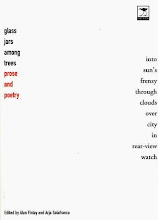
Glass Jars Among Trees is a collection of current South African writing – an alternative anthology of South African prose and poetry that is fresh, compelling and different.
The editors, Arja Salafranca and Alan Finlay, have selected works from published and unpublished writers that reflect a wide variety of writing styles and formats.
Stories in the form of mock movie reviews and film scripts, diary entries, song lyrics, poetry, short fiction, essays, comedy – even opera – make this a comprehensive showcase of South Africa’s new generation of writers.
Kay Benno’s highly inventive “Men with Dead Mothers” tells its rather unusual story through film reviews, while Finuala Dowling’s “Stand-Up Comic” delivers a wry, slightly sad story of a woman’s experiences through the speech of a comedian. “Lioness”, Alan Kolski Horwitz’s slowly unfolding story reveals the trials of a second marriage, and the convoluted triangles couples negotiate as families merge and stepfamilies are formed.
On the nonfiction front, Gary Cummiskey’s essay, “Who was Sinclair Beiles?” probes the life and art of Beiles, South Africa’s sole Beat poet.
The diary entries are numerous and engaging, proving quite concisely that diary writing isn’t a lost art that only the Victorians practised in their flourishing penmanship. Ursula Cox and Carol Leff explore what it means to be women at the close of the 20th century, while Anne Marie du Preez Bezdrob lives through the war in Bosnia in 1993 in “Once a Thing is Known – War Diary of a South African Peacekeeper in Bosnia”, bringing to life just what it feels like to be caught up in a war.
Kobus Moolman, on the other hand, is writing in a time of peace, a time of artistic solitude in “Boom St Journal” and Karoo Notebook, bringing to his notebook a series of vignettes, snapshots and thoughts on writing.
Glass Jar Among Trees Homepage
Glass Jars Among Trees by Alan Finlay and Arja Salafranca
EAN: 9781919931234
Buy Glass Jars Among Trees via Bookfinder
(Published on BookSA)
Glass Jars Among Trees is a collection of current South African writing – an alternative anthology of South African prose and poetry that is fresh, compelling and different.
The editors, Arja Salafranca and Alan Finlay, have selected works from published and unpublished writers that reflect a wide variety of writing styles and formats.
Stories in the form of mock movie reviews and film scripts, diary entries, song lyrics, poetry, short fiction, essays, comedy – even opera – make this a comprehensive showcase of South Africa’s new generation of writers.
Kay Benno’s highly inventive “Men with Dead Mothers” tells its rather unusual story through film reviews, while Finuala Dowling’s “Stand-Up Comic” delivers a wry, slightly sad story of a woman’s experiences through the speech of a comedian. “Lioness”, Alan Kolski Horwitz’s slowly unfolding story reveals the trials of a second marriage, and the convoluted triangles couples negotiate as families merge and stepfamilies are formed.
On the nonfiction front, Gary Cummiskey’s essay, “Who was Sinclair Beiles?” probes the life and art of Beiles, South Africa’s sole Beat poet.
The diary entries are numerous and engaging, proving quite concisely that diary writing isn’t a lost art that only the Victorians practised in their flourishing penmanship. Ursula Cox and Carol Leff explore what it means to be women at the close of the 20th century, while Anne Marie du Preez Bezdrob lives through the war in Bosnia in 1993 in “Once a Thing is Known – War Diary of a South African Peacekeeper in Bosnia”, bringing to life just what it feels like to be caught up in a war.
Kobus Moolman, on the other hand, is writing in a time of peace, a time of artistic solitude in “Boom St Journal” and Karoo Notebook, bringing to his notebook a series of vignettes, snapshots and thoughts on writing.
Glass Jar Among Trees Homepage
Glass Jars Among Trees by Alan Finlay and Arja Salafranca
EAN: 9781919931234
Buy Glass Jars Among Trees via Bookfinder
(Published on BookSA)
Subscribe to:
Posts (Atom)


.jpg)
