Showing posts with label Dye Hard Press. Show all posts

Tuesday, April 9, 2019

Reg Rumney reviews Beyond Touch


I can think of no greater compliment to a poet than to say that you have read all the poems in a volume. Often, I dip into poetry books, reading some poems that look promising, or which particularly resonate, and pass over the rest. I read all of the poems in ‘Beyond Touch’ by Arja Salafranca.


Read more ...

Sunday, May 3, 2015

PEN SA’s Q&A with Arja Salafranca

Favourite South African novel / poem?
I don’t have a particular favourite South African poem or novel and that does change with every new book read – but I do enjoy novels by South African novelists such as Damon Galgut and Ingrid Winterbach, for instance. I’m looking very forward to reading Craig Higginson’s just published The Dream House, andFinuala Dowling’s The Fetch... Read more.

Tuesday, November 19, 2013

Arja Salafranca at launch of Off-ramp, Love Books, Melville November 13


Arja Salafranca at the launch of Off-ramp, by Gary Cummiskey, at Love Books, Melville, on November 13 2013. Artist and poet Lionel Murcott in foreground.

New Book, New Broom, New Coin - the launch of Off-ramp, by Rene Bohnen


Die virus tref haar tussen twee verkeersligte naby Wespark. Sy sweet en bestuur, sweet en bestuur, konsentreer deur die spitsverkeer en die yskoue prikkels in haar voete en hande. Genadiglik maak sy dit tot by die parkeer-area, sluit die motor en storm dramaties verby die wit tafels met die wynglase, verby die silwer ysemmer en camembert-broodjies, tot by die badkamer. Hoe lank bly sy daar, nee sy weet nie – deur die venster hoor sy vaagweg hoe lag en gesels die gaste wat nou reeds aangekom het vir die boekbekendstelling. ʼn Skoonmaker kom in met emmer en mop, verbaas om ʼn vrou op die vloer te sien lê naby die wasbak. Is daar fout, wil sy weet. Nee, antwoord die vrou, ek is doodreg, ek het kom foto’s neem. Ek voel soos ʼn karakter in ‘n film van David Lynch, dink sy. Of in een van Gary Cummiskey se kortverhale...Read more here

Thursday, July 11, 2013

From mimetic punctiliousness to imaginative free play: a review of The Edge of Things

In 1958 Randall Jarrell, the American poet, edited and brought out a collection of stories, Randall Jarrell’s Book of Stories, which contains a famous introduction. The book was long out of print but has been recently republished as a New York Review Books Classic (2002). It is, naturally, very difficult to generalise about a book such as the one under review, but there is one section of Jarrell’s introduction that seems pertinent to The Edge of Things, in its mixture of complexity and comprehensiveness:

It is so good, our stories believe, simply to remember: their elementary delight in recognition, familiarity, mimesis, is another aspect of their obsession with all the likenesses of the universe, those metaphors that Proust called essential to style. Stories want to know: everything from the first blaze and breathlessness and fragrance to the last law and structure, but, too, stories don’t want to know, don’t want to care, just want to do as they please. (Jarrell 2002: x)

The range of the story: from mimetic punctiliousness to imaginative free play. Arja Salafranca’s task, as compiler ofThe Edge of Things, is not to ponder the nature of short fiction; it is to present as many works as possible, with an eye on quality, in order to promote the genre in this country. She notes that the stories submitted for publication in the book showed ‘an astonishing variety of narratives and approaches, shifting from realism to playful absurdity and crossing the boundaries from the strictly fictional to something that sits just beyond fiction, but isn’t quite nonfiction either’ (p. 7). Jarrell would have approved.

Looking at the stories themselves one finds it hard to pick out those that deserve special mention, but let me refer to some. ‘Bounce’ (p. 9), by Jayne Bauling, is a curiously gripping account (perhaps because this reviewer has tried to do the same) of the attempted rescue of a baby lourie, psychologically bound to the loss of a murdered partner. Salafranca’s own ‘The Iron Lung’ (p.18), juxtaposes two first-person accounts, those of mother and daughter, about life with the iron lung device; the device assumes a figurative significance. Cunningly different from other stories is Liesl Jobson’s ‘You pay for the view: twenty tips for super pics’ (p. 30), a life story constructed around the said tips and moments captured as camera events. The events begin with
‘1. Hold it steady’, and end with ‘20. Watch the light’, and cover a period, not always in strictly chronological order, of 32 years. In this and other stories failed marriages are at issue. I think of Gillian Schutte’s ‘Doubt’ (p. 50), with its erotic daydreams, and Karina Magdalena Szczurek’s ‘The Basket’ (p. 62), where the death of a newly-retired husband in a motorbike accident actually brings the protagonist (and the reader) a sense of relief.

In the collection’s eponymous ‘The edge of things’ (p. 78), by Jenna Mervis, the protagonist is alone with her dog in a cottage on the edge of suburban space, that appears to be spied on by possible intruders. She is without, or is separated from, a partner, and the narrator uses this absence and her sense of vulnerability to create suspense. In the end, though, Samson the dog, in the middle of a moonlit night, leads her outdoors, away from her locks and alarms, into a magical dream dimension, ‘on the edge of things’ in a different sense from that originally suggested.

Pravasan Pillay’s ‘Mr Essop’ (p.137) is a matter-of-fact, Hemingwayesque account of an instance of coldly administered cruelty to a child, with some fine moments of dialogue in Chatsworth dialect. Again, it is obviously impossible to mention all the stories in the book, but let me conclude with a brief look at Dan Wylie’s ‘Solitude’ (p. 256). Here we find a punctiliously crafted story, in deed. The protagonist is an aloof, cynical academic, complacently single, with a distaste for the life around him. He works on a crossword puzzle, clue by clue. The puzzle proves intrinsic to the plot, as the life around him, with its grubbiness and despair, enters into his puzzle (though he remains imperturbable.

The book will appeal to lovers of fiction and narrative in whatever forms. Those who relish detail, those who desire free play, are catered for. Not all the stories are of the same quality, but each, in its way, is enjoyable, and is reflective of the old cliché that everyone carries a story, or stories, within him or her. There is something of this democracy of the narrative urge in these stories, which makes of them a useful and enlightening panorama of local experience, states of mind, and states of emotion.

Nicholas Meihuizen
First published in Literator, North-West University, South Africa

Tuesday, June 19, 2012

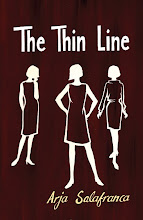
The Edge of Things and The Thin Line on display at the Cape Town Book Fair 2012


The Edge of Things: South African Short Fiction, was published by Dye Hard Press in 2011 and The Thin Line was published by Modjaji Books in 2010. 

Tuesday, November 8, 2011

Review of The Edge of Things, in Wordsetc


An edge is the most exhilarating point for a story to place itself. Ask any reader. We don’t need cliff-scrabbling above a literal precipice; masters (and mistresses) of the form can hollow out spaces of mystery and risk beneath the most prosaic inner or outer landscape. But what we do ask, as readers, is that the threshold matter somehow and that we are surprised and, perhaps, even changed when the story crosses it.

The Edge of Things, then, is an enticing title and a flexible one too, stretching to cover all manner of brinks. Characters cross the endlessly fascinating boundary between innocence and experience, naivety and self-knowledge, one sharing his first kiss at the company picnic, another beheading her first chicken.

What would infidelity look like? one story wonders, while another shows us what looks like cheating but turns out, in the flick of a needle, to be bridal branding instead. Worlds collide: matter-of-fact house renovations clang against soul-exchanges in one story while in another an empty house invites a range of intruders, from teenage lovers to lowering-the-tone buyers to symbolic creatures, recalling District 9, that challenge notions of inside and out.

Liesl Jobson’s “tips for super pics” apply with wit and pain to parent-child relationships, tracing shifts that the photographer protagonist catches out of the corner of her eye while her lens is trained elsewhere. Beatrice Lamwaka writes about a schoolgirl who wants to win a race on sports day. She has, after all, trained hard, fleeing rebel soldiers who abducted her. “I outran them so that’s an A+ for me. If anyone needs more practice in athletics, I’m sure it’s not me.”

Sometimes, an edge is sharp enough to draw blood. Then there’s literary edginess, fun with texts, intertextuality. Iconoclasm (“I don’t like Coetzee”) meets homage, for example, in Jeanne Hromnik’s exploration of new-South-African father figures both lecherous and pathetic. Perd Booysen amuses himself, and us too, with the device of the discovered journal, inadmissible as historical evidence because of its fictional finesse.

In David wa Maahlamela’s playful bus ride across the fiction/non-fiction frontier, we meet both Wordsetc and its editor, Phakama Mbonambi. In the optimistic view of the narrator, also called David, writers who describe lived experience “know exactly the impression they are intending to give their readers”. But this is perilous terrain for less adept scribes.

An event that bit your heart for real needs just as much construction on the page as a situation you make up from scratch. You can’t refer to that day, you must weave it, as Bernard Levinson does in “Tokai”. We have no idea whether the story draws on his life or his imagination or some alchemical meld of the two. What matters is that he shapes place, time and action so fully, so deftly that, like the narrator, we are moved by the mysterious intensity of the last scene.

The Edge of Things is in every sense a mixed bag. Alongside Levinson’s story, gems include Salafranca’s unforgettable image of a mother in an iron lung and Pravasan Pillay’s characters, dialogue and spicy small-canvas family drama.

Silke Heiss’s “Don’t Take Me for Free”, arguably Best in Show, nimbly outstrips our expectations. Like its trucker-clown narrator, Vonny, the story “was built to change”.

In Vonny’s extended appeal to her lover, “All-I-Have, Azar”, the  language is as elating as the ride across ostrich and canola country in a bright-eyed van “with its massive, roaring heart and load continuing to doer ’n gone”.

The collection’s subtitle – South African short fiction – proposes that we read the stories as a kind of national sampler. (In a one-off slip, the introduction makes an unwarranted claim to be presenting writing “on our continent”.) Clearly, South African fiction has moved beyond the imperative to be earnest, political or even particularly South African. Mischief is now acceptable story territory, while Fred de Vries’s chilling tale could take place in almost any big city and Aryan Kaganof’s junkies claim that Amsterdam may as well be Durban, “there’s no fucking difference. Bars are the same everywhere. Drugs are the same everywhere.” But it is also true that, as per Hromnik, “the past is hungry”.

Several stories tackle a mix of  race and privilege, either head-on or obliquely. In “Telephoning the Enemy”, for instance, Hans Pienaar crosses the “what if ?” line for an intriguing revisit of apartheid-era violence.

Solitude, as Salafranca notes in the introduction, features in many of the stories. We glimpse various anxious, closed, self-referential worlds. A man sits at a café table in the last story, telling himself consoling untruths and inking “NARCISSIST” into his crossword puzzle as he fends off contact.

What feels like a limitation, though, looking back over the collection, is neither inner landscapes nor low spirits (excellent fiction fodder) but rather a sense of stasis in some of the stories, a single note struck and held, Act 1 from curtain up to curtain down.

For these writers and for all the rest of us, Jenna Mervis’s story offers advice. Her protagonist “mentions nothing of … the fingernails of trees that have begun to tear at her corrugated roof in the night”. She looks for “a sign that … that the dangers outside have become manifest”. But by the end (and this won’t spoil it for you), she steps off the edge of the deck and plunges into the veld. Why not, writers? Instead of tamping down tension, why not let it explode? Approach the edge. Plunge. Leap.

REVIEWER: A Zimbabwean filmmaker and writer,  Annie Holmes has published short stories in the US and Zimbabwe and a short memoir,Good Red, in Canada. She co-edited, with Peter Orner, Hope Deferred: Narratives of Zimbabwean Lives

(Published in Wordsetc, Third Quarter 2011)

Friday, November 4, 2011

Voila! chatroom: an interview with Arja Salafranca, by Nikki Temkin


Arja Salafranca selected the short stories for The Edge of Things, a compilation of South African short stories. I chatted to her.

NIKKI:  What were the criteria for selection forThe Edge of Things?
ARJA: Firstly, a story had to move and touch me, make me feel something, reflect on some aspects of life and our experiences here. Secondly, I was looking at excellence in terms of telling a story, well-crafted stories that begin with something deep inside and move readers because these were tales that just had to be told.

N: What was the inspiration for this book?
A: The book was initially meant to be an edition of the literary journal, Green Dragon. I received nearly 100 submissions and then selected the 24 stories that make up the anthology. It was too large for a journal, so I suggested that it become a special short fiction edition. I decided to do it because of my own love of the short story – as both a short story writer and as a prodigious reader of the genre.

N: Can you tell us about some of the themes of the book?
A: Some of the stories centre on solitude – and the ramifications of that, from loneliness, to a sense of fulfilment that also results from time spent alone, some centre on relationships experienced, some are about the outsider from society. Some of the stories explore the mother-daughter bond, some look at childhood experiences, some reach deep into South Africa’s past, looking at how those experiences have shaped those in the stories. Others look at identity issues in post-apartheid South Africa, and my own story deals with polio and the mother-daughter bond.

N: What do you think of South African writing currently?
A: It’s extremely vibrant and healthy – certainly in terms of the volume of fiction being produced, and we have some world-class writers, both established as well as emerging. South Africans are now so much more receptive to reading local literature – and there’s also such a range – from literary, to science fiction to crime thrillers and more.

N: Who are some of your favourite local authors?
A: I love Damon Galgut’s fierce, spare, almost uncompromising vision; David Medalie’s collection of short stories The Mistress’s Dog as well as Henrietta Rose-Innes’s Homing. I also love the poetry of Eva Bezwoda Royston (sadly she committed suicide in the 1970s). It’s personal, confessional poetry full of rich, dark and vivid imagery.

(Published in Voila!, Issue Number 8, 2011) 

Thursday, October 13, 2011

Eclectic mix of local short stories, by Janet van Eeden

Book of the Week: The Cream of South African Writers
The editor of this eclectic collection of short stories, Arja Salafranca, sifted through over 100 submissions before she chose stories from the cream of South African writers. There was no theme as such, but it seems as if the stories chosen examine people who are in extreme situations,emotionally or physically.

For example, Arja Salafranca’s moving story about a woman forced to live in a restrictive apparatus in “Iron Lung” is a million miles away stylistically from Aryan Kaganof’s tale of decadence and debauchery on a night out in Durban in “Same Difference.” What is similar, though, is both stories deal with  someone in extremis. The narrator of Kaganof's story is the edge of the emotional abyss. The young woman watching her mother in "Iron Lung" is too. There is no easy way to contemplate a happy future when someone you love is crippled in this way.

There are many gems in this sparkling collection. The enjoyment comes not only from the juxtaposition of many different writers, but also from reading stories with such a variety of subjects.

For example, Liesl Jobson’s “You Pay for The View: Twenty Tips for Super Pics” is a series of verbal snapshots of pivotal moments of a mother trying to find a connection with her children. It is written with poignancy and deep longing. “Doubt” by Gillian Schutte is a study of how passion can seep out of a marriage once the chase is over and when feelings of irrelevance grow due to being part of a couple.

Jenna Mervis’s “The Edge of Things” explores paranormal paranoia in a tangible way and examines the valid fear women feel on a daily basis.

The eternal clash with “the other” is explored in Gail Dendy’s “The Intruders”.  Perd Booysen’s “Sinners and Sinkholes” is a delightful modern-day Hermann Charles Bosmanesque tale of ghost towns and gullibility in the arid wasteland of the Karoo.


There are too many stories to mention individually, and some lend themselves to rereading many times. This is the beauty of the colection: there is something to appeal to all astes. And, fortunately, the real star of The Edge of Thingsis the genre of the short story itself.

(Published in The Witness, October 12, 2011)

Friday, August 12, 2011

Short story form challenges and inspires writers: a report by Leila Bloch on the Cape Town launch of The Edge of Things

For an anthology of short stories, The Edge of Things includes both depth and scope, with several writers who seem (to varying degrees) unafraid of entering new literary territory. Published by Dye Hard Press, selected and edited by Arja Salafranca, these 24 stories are a special fiction edition of the literary journal Green Dragon.

At the launch, facilitated by Salafranca, a predominantly female group of writers clustered around a podium and steered the familiar how-and-why, question-and-answer session towards more spontaneous conversation. During the evening writers explained how they found inspiration while also skilfully adapting their writing to the short story format...Read more here

Wednesday, August 3, 2011

Report on the Cape Town launch of The Edge of Things

Last Thursday night saw the Cape Town launch of The Edge of Things, an anthology of South African short fiction selected by me and published by Dye Hard Press. This followed a month after the Jozi launch at Love Books in Melville.

Hosted by The Book Lounge, the launch was a chance for me to meet some of the Cape Town writers with whom I’d previously only had email dealings, as well as a chance to catch up with writing friends...Read more here

Friday, July 22, 2011

Podcast of Interview on Radio Today about The Edge of Things

Arja Salafranca was interviewed by Sue Grant-Marshall about the anthology of South African short fiction, The Edge of Things, on the Reading Matters programme for Radio Today on July 14th. 

You can listen to the podcast of the interview here.

Wednesday, July 20, 2011

Kate Turkington reviews The Edge of Things

Short stories, as any writer knows, are possibly the most difficult literary form. In the space of a few pages, the storyteller must condense the thoughts, feelings and actions of his or her characters and then come to a conclusion.

The Edge of Things (Dye Hard Press) edited by Arja Salafranca, herself an award-winning poet and short storyteller, gives us the best of contemporary South African writers. There are many themes with many twists.

The title story The Edge of Things by Jenna Mervis marries stark everyday South African reality to a wondrous fantasy. Arja’s own story The Iron Lung reminds us that imprisonment is not only physical but emotional and spiritual. The Company Christmas Party by Hamilton Wende is about that tender first love, and Mr Essop by Pravasan Pillay tells the story of a charming old Indian pensioner who rents a cottage on a friend’s property with unforeseen circumstances. The stories are dazzlingly diverse: funny, sad, thought-provoking and relevant. Keep them by your bed or in your bag for those school lift waits.

Published on http://www.joburg.co.za/ here

Thursday, July 14, 2011

Loneliness a recurring theme in this collection: a review of The Edge of Things, by Gwen Podbrey

The short story has come back into its own over the past few years, possibly because time-strapped readers find them easier to manage than a lengthy novel.

This collection includes contributions from a remarkably diverse range of writers, including Gail Dendy, Jenna Mervis, Gillian Schutte and Jayne Bauling.

If there is one central theme to the book, it is alienation (or, to use real name, loneliness). The stories capture encounters and experiences which tilt us over into the cracks between the crevices of contemporary life: those dark, uncharted spaces where needs are failed by niceties, and pain and perdition walk hand in hand.

Pick of the crop – by a long way – is Bernard Levinson’s superb “Tokai”, which recounts his delivery of an Afrikaans couple, the Bezuidenhout’s, baby in the dead of night. But the birth is complicated and the womb goes into violent contractions, forcing him to manually secure it and staunch its gushing of blood.

For hours he sits, his hand in the uterus of his semi-comatose patient, feeling this incubator of life convulse, enfold his fingers and relay to him its arcana.

“There was a slight shift of tempo. I listened with the fingers of my fist. Unmistakably, I heard the womb flutter and shift itself minutely over my fist... It stretched and gripped. Stretched again and squeezed my fist firmly. I inched my hand out. A secret dialogue between my hand and the womb. My blunt fist - mute and solid. The womb excited, chattering and intimately pressing and caressing my hand.”

Witnessing the drama of this birth - like the primordial one and, indeed, all births - Kleinman Bezuidenhout is engulfed in agony as acute as his wife’s. The next morning, Levinson - preparing to leave - sees him engaged in a ritual which matches, in every detail, the intensity and power of the previous night’s crisis.

The story is an unforgettable glimpse into the soul of the healer, whose patients’ trust in him can crucify as often as it coronates, and whose brief role in their lives - as an outsider, observing and intervening, but never sharing - carries a unique loneliness.

Later, in Liesl Jobson’s “You Pay for the View: Twenty Tips for Super Pics”, we enter the alienation of a compulsive photographer unable to fully engage with her life, and attempting instead to capture its essence through her lens “because the camera never lies”.

Yet it does, for it lacks the vocabulary to capture the truth of locations and individuals, how they imbed themselves in the DNA of the soul and remain there forever, a testimony to life and loss. These are not within the province of pixel and resolution, but of another documenting medium altogether.

The third exceptional story in the collection, Pravasan Pillay’s “Mr Essop”, recounts the arrival of a seemingly kindly, placid lodger at his parents’ home. The author, still a child, notes the growing friendship between the boarder (Mr Essop) and his father - both lonely men - and their mutual pleasure at discovering the values they have in common. But when Essop suddenly shows a brutal side to his nature, shock is added to disappointment.

Aryan Kaganof’s “Same Difference” explores yet another kind of alienation: that of drug users, whose subculture and exclusion from mainstream society force them to band together, unwillingly recognising in each other kindred tortured spirits and putting on a show of bravado to conceal their desperation.

In this ugly, treacherous world, the only allegiances which matter, last as long as it takes to shoot up a crystal meth hit.

“The upstairs toilets are for blowjobs and the schnarf sessions. The outside toilets are for quick shags and schnarf sessions … Tretchikoff girls clustered on the walls and in the mirror. Looking down serenely on the useless lives of all the pastel customers. Useless, all of it. Useless.”

As the narrator ends yet another all-night session with his gang of users in the fetid, filthy basement of a nightclub, and the sun announces the break of yet another unwelcome day, he reflects: “I’m frightened. I’m lonely. Sometimes I feel close to death. But at least I scored tonight… There is no reason to stay alive. But I refuse to bribe the reaper to come and take me.”

Hans Pienaar’s contribution, Telephoning the Enemy”, makes a brave, but failed, effort to explore the alienation of white, apartheid-bound South Africans on the verge of political change. As bombs hidden in sidewalk garbage cans claim one civilian victim after another during the early 1980s, racist beliefs are heightened and the gap between terrorist and victim appears unbreachable.

Not all the stories have the gravitas or compositional skill to sustain the reader’s interest. Angelina N Sithebe’s cumbersome, melodramatic and poorly structured “Sepia”, for example, features characters who are utterly implausible, while Rosemund Handler’s “Clueless” exhumes a stale, clichéd story line: white, lonely madam coming on to a man across the colour bar, followed by a delicious explosion of eroticism and new awareness of each other as human beings. Hardly groundbreaking stuff.

Still, with 22 out of 24 stories offering piercing insights and showcasing a range of exciting writing talent, the collection is one of the best to emerge in recent years. Salafranca’s eloquent and moving foreword whet one’s appetite for the feast to come and the contributors’ profiles at the back of the book give perspective to the voices on the pages, which demand - and deserve - an audience.

(Published in SA Jewish Report, July 8, 2001)

Tuesday, July 12, 2011

Short but rich South African view - a review of The Edge of Things by Jane Rosenthal

Two collections of short stories illustrate why the genre continues to garner accolades for the country


The Edge of Things: South African short fiction, selected by Arja Salafranca, Dye Hard Press

African Pens 2011, Jacana

Though they may have been somewhat neglected in recent years, there is a long tradition of short stories in South African fiction. Some of the most famous writers are Pauline Smith, Can Themba and Dan Jacobson; more recently Ivan Vladislavic, David Medalie and Zoe Wicomb spring to mind. Practitioners of this form were hard at work last year if one judges by the two collections reviewed here. As with literary awards for fiction, it's a matter of some chance as to what appears in any given year and 2010 seems to have been particularly good.

Arja Salafranca originally intended The Edge of Things to be a special short-fiction edition of the journal Green Dragon, but as she had so many submissions, it became a full-length book. This interesting and wide-ranging selection reflects the richness of the South African experience. It begins with several pieces that delineate the complexities of personal relationships, including mothers and daughters, dysfunctional marriages and the interior lives of women - all situations in which the protagonists seem to be sailing close to the edge of things.

The title piece, The Edge of Things by Jenna Mervis, is a particularly fine story about a woman and her dog, alone in a remote place, which is beset by fear and fantasy.

Other strong but even darker pieces include Tokai by Bernard Levinson, a brooding, sexualised and masculien take on birth; Telephoning the Enemy by Hans Pienaar recounts the effects of a bomb on a conservative Pretoria community; and in Solitude Dan Wylie an isolated coffee-drinker who enjoys crossword puzzles observes the lives of others from the periphery. Margie Orford's The Gift is an erotic and original meditation on freedom and commitment. Its contrast to these, Hamilton Wende's The Company Christmas Party evokes adolescents careening uncertainly but cheerfully into adulthood.

Pravasan Pillay's Mr Essop is a precise cameo of language and life in Chatsworth, in which the protagonist at first appears to be the perfect tenant.

Although there are a few less felicitious inclusions, the standard is remarably sustained. Most memorable would probably be Silke Heiss's Don't Take Me for Free, narrated by Vonny, a woman whose hold on her job as a furniture-van driver, and on her sometimes man, Azar, is extremely tenuous. This unusual story asserts the humanity of the homeless, poor and underemployed. For Vonny and Azar the stabilising symbol of their lives is a carved piece of cedar wood. This item,made by Azar, is as abitrary as fate but is seen as a spine and a road that helps to hold them. Poetic and deep, Vonny's strange existence imprints itself on the reader's mind.

The 500 stories originally submitted for African Pens 2011 were read and shortlisted to 21 by variuous volunteers (PEN readers and an editorial board) before being judged by JM Coetzee. Although Coetzee considers the standard of this year's entries to be "generally higher", he said that "the kind of short story writer we are all hoping that an award of this magnitude will attract - the newcomer with naked talent, a feel for language and a fresh vision of the world - stubbornly fails to arrive".

I thought this a little stringent - there is plenty of "naked talent" and "feel for language" - and even considerable "fresh vision". Stories that particularly show "fresh vision" would include Claremont Park (Bobby Jordan), Pinch (Martin Hatchuel) and Evolution (Jayne Bauling).

Jordan's story takes one deep into the experience of people on the fringes of Cape Town society in a lyrically light and accepting way not seen by this reader before. Pinch could be a sidebar to Deneys Reitz's great classic about the South African Anglo-Boer War, Commando, with an entirely unexpected flare, both tender and brutal. In Evolution Bauling takes the reader to a place where our existence as the dominant primate species is challenged, perhaps deservedly so. In these three we have fresh visions of the present, past and future.

The winning story, The Story, by James Whyle, is a gem. Set in Pringle Bay, it has more than one narrative layered into its cleanly written pages and concerns a man, his driver's licence, a cop, a baboon and several "whatifs". In second place is Heatwave by Beth Hunt, in which a woman, surrounded by love and good fortune, examines her conscience when a lover dies.

Of the 21 stories I considered 15 to be very good - and the rest to be almost as good. Names that are already known to readers include Liesl Jobson, with her intense, perceptive style, and Sarah Lotz, whose The Pigeon Fancier is funny as well as sad.

Both these collections of short fiction are not to be missed and contain stories that will join the ranks of the established tradition.

(Published in Mail & Guardian, July 8 2011)