Stories: All-New Tales
edited by Neil Gaiman and Al Sarrantonio
(Headline Review, R185)
Short stories: we may lump them together in one big homogenous thing. Sure, there are differences, but basically a story is a story, not so? Yet, there are as many types of stories as there are say, novels, from literary to thriller, romance to adventure.
I admit that I like my stories rather literary: within my own strictly defined limits, characters emerge from page, grow, become aware, and carry this awareness of something defining them off the page.
However, the stories in this anthology stretched me somewhat. Horror rubs shoulders with fantasy, new vampires sprout a special tooth to suck blood or develop a fetish for chickens, and the past develops new underwater dimensions.
There are a few "literary" stories within this volume - in which ordinary people love, laugh and die and there isn't a vampire or strange being in sight - but the majority of these tales plumb depths which I don't normally reach in my own reading of the genre.
Enjoy might be too facile a word to describe my experience of these stories. At times I was horrified and disgusted, I was intrigued, I was admiring.
I kept on reading, for the most part, because, as the editors Neil Gaiman and Al Sarrantonio write in their introduction, "what we wanted to read were stories that made us care, stories that forced us to turn the page. And yes, we wanted good writing."
The stories in this collection are polished, crafted, well-edited gems, they keep you turning the page, and the images created in your mind live on long after the reading.
Roddy Doyle's gruesome Blood is a case in point turns on a husband's sudden taste for the red stuff, to the point where he takes to murdering his neighbour's chickens while trying to hide this lust from his spouse. The surprise of the story is revealed right at the end? and it's a surprise to the husband himself.
Blood lust is the focus of Walter Mosley's Juvenal Nyx, a meandering story of how a perfectly ordinary man, a member of a Black Students Union, is turned into a man who lives by night and alone, surviving on the blood of others. This long tale also shows what happens when he attempts to live again in the world, emerging from the darkness of his solitary vampireness.
Joyce Carol Oates, a master of the genre, contributes Fossil-Figures, a strange tale of two twin brothers. One is strong and healthy, a popular A-grader who will go into politics with his winning smile and winning ways; his brother is sickly, weak, a victim of his brother's avaricious greed in the womb, or so the narrative suggests. The twins grow up, their lives dissect, diverge, then ultimately come together. A quietly powerful story, yet there's gothic horror wrapped up in the package.
Violence and murder form the spine of a number of exceptional stories.
There's Neil Gaiman's The Truth is a Cave in the Black Mountains, a story set some time ago in which two men set out in search of treasure, and yet mistrust will dog them and splinter through.
Lawrence Block's Catch and Release is equally chilling in its presentation of a serial killer, while Jeffrey Deaver's excellent The Therapist is a horrifying yet gripping tale of man in the vice of mental illness.
I loved the fantastical Goblin Lake by Michael Swanwick, in which a man journeys to the bottom of a lake, to emerge with truths and realisations about the nature of paths taken, and not taken.
Meanwhile the narrator in Kat Howard's A Life in Fictions suffers from the fact that her lover keeps writing her into his stories, and thus influencing the course of her own reality. A mind-bending story, and delicious in the telling.
Equally fun was Diana Wynne Jones's Samantha's Diary set in the year 2?, in which the young narrator Samantha writes wittily about a secret admirer who keeps sending her live birds, from swans to pigeons and a partridge or two.
Finally, I also thoroughly enjoyed Michael Moorcock's simply titled Stories in which the lives of a group of friends, from their 20s on to life in their 60s is told in simple language, language that swoops and falls from event to event.
A real delight.
Published The Star Tonight December 9 2010
Tuesday, January 18, 2011

Saturday, January 15, 2011
Winter afternoons
Winter afternoons the pink wall is
cold grey, the sun oblique, hiding,
you can feel the chill in the
shadows of the paint.
Even the leaves look cold.
Published in New Contrast, Summer 2010
cold grey, the sun oblique, hiding,
you can feel the chill in the
shadows of the paint.
Even the leaves look cold.
Published in New Contrast, Summer 2010

Forthcoming publication from Dye Hard Press: The Edge of Things
The Edge of Things is a special issue of Green Dragon, to be published by Dye Hard Press, and consists of 24 short stories selected by Arja Salafranca. The authors are Jayne Bauling, Arja Salafranca, Liesl Jobson, Gillian Schutte, Karina Magdalena Szczurek, Jenna Mervis, Jennifer Lean, Fred de Vries, Margie Orford, Aryan Kaganof, Bernard Levinson, Hamilton Wende, Pravasan Pillay, Beatrice Lakwana, Hans Pienaar, Rosemund Handler, Tiah Beautement, Angelina N Sithebe, Jeanne Hromnik, David wa Maahlamela, Perd Booysen, Gail Dendy, Silke Heiss and Dan Wylie.
Publication is scheduled for March 2011.
More details to follow.
Publication is scheduled for March 2011.
More details to follow.
Thursday, December 23, 2010
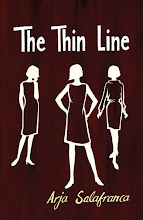
Review of The Thin Line - Joan Hambidge in Die Burger

The Thin Line is ’n versameling kortverhale wat ’n mens eenvoudig nie kan neersit nie.
Arja Salafranca ondersoek die subtiele verbintenisse tussen mense, soos vroue wat saam koffiedrink, maar mekaar sonder woorde kritiseer, of, met giftige uitinge aanval; eksgeliefdes wat saamreis en in ’n vreemde landskap ontdek die verhouding werk nie meer nie, en sal nooit weer werk nie; ’n “verhouding” tussen twee mense wat liefdeloos is en tog uitloop op ’n desperate seksuele verkenning; ’n vrou wat haar manlike geliefde se eks-meisie seksueel begeer, najaag en ’n slot wat uitloop op ellende; ’n ondersoek na vetsug met ’n jong meisie wat haarself letterlik doodeet as die subteks . . Read more here
Arja Salafranca ondersoek die subtiele verbintenisse tussen mense, soos vroue wat saam koffiedrink, maar mekaar sonder woorde kritiseer, of, met giftige uitinge aanval; eksgeliefdes wat saamreis en in ’n vreemde landskap ontdek die verhouding werk nie meer nie, en sal nooit weer werk nie; ’n “verhouding” tussen twee mense wat liefdeloos is en tog uitloop op ’n desperate seksuele verkenning; ’n vrou wat haar manlike geliefde se eks-meisie seksueel begeer, najaag en ’n slot wat uitloop op ellende; ’n ondersoek na vetsug met ’n jong meisie wat haarself letterlik doodeet as die subteks . . Read more here
Monday, December 6, 2010
Short story short-listed for the Thomas Pringle Award
My short story ' Strangers', published in New Contrast literaty journal in 2009, has been short-listed for the Thomas Pringle Award by the South African English Academy. Read more here
Friday, December 3, 2010
BookEx, Sandton Comvention Centre, Johannesburg, November 2010: Discussion panel on short fiction
 Arja Salafranca and Lauren Beukes
 David Chislett and Arja Salafranca
 David Chislett, Arja Salafranca and Lauren Beukes
 From left: David Chislett, Arja Salafranca, Lauren Beukes, David Medalie and Louis Greenberg.
BookEx, Sandton Comvention Centre, Johannesburg, November 2010: Short fiction discussion panel
 From left: Arja Salafranca, David Chislett, Lauren Beukes, Louis Greenberg and David Medalie.
Photo: Helen Holyoake.
Monday, November 22, 2010
Nature proves you can step in the same river twice
There's the old saying that you cannot step in the same river twice. It’s credited to Heraclitus, a Greek philosopher who lived from 540 BC to 480 BC and the full quote is: “You could not step twice into the same river; for other waters are ever flowing on to you.”
Meaning, of course, among many other explanations, that you can’t try and retrieve or recover the past – the current has flowed on, there is another sense at play, you are a different person, you cannot grab at the intangible, at what has been and is over.
I thought so, too. Recreated experiences fall flat and yet, I think, after several experiences this year, that you can succeed in nabbing back a bit of the past, and making sense of what has been.
The experience will be different, you look on with older eyes, perhaps less naive, and you must make peace with that. For you can step in the same river twice, and sometimes the experience is ultimately satisfying. I attended a 20-year school reunion earlier this year – and found that while we had all moved on, a different sort of connection was achieved and ultimately cemented.
A few weeks ago, I returned to Utopia. I first went there at the age of eight with a large crowd of adults and children. Set within the mountains of the Magaliesberg, there are more than 100 self-catering, rustic A-frame chalets dotted around the wild nature reserve.
A river runs through it, you can hike the nearby mountains, swim in the pool, play tennis near the clubhouse. The name Utopia is aptly chosen – it’s an idyll. And never more so than for an eight-year-old child running wild, swimming the river that’s flanked by dusty pink and golden rocks.
I’ve never forgotten my time there, through all the years and subsequent travels to other places and other continents, although I did not consciously plan to return.
But a few years ago I was asked to write a short story for an anthology, and the place came back in my imagination. It had been too long – the story didn’t gel, memory really had dimmed the tarnish and the details – but the seed had been born.
I had to go back. Instead I went overseas a handful of times, travelled around the country, and always the memory of Utopia remained, I even Googled it a few times.
But the idea had taken root and one day I was explaining this place called Utopia to a friend, telling her all about it. She interjected – she knew the place well and had been going since a decade before. She had bought one of the units with her husband.
A hushed silence followed this statement. A plan was born.
Weeks later, we made our way to Utopia for a weekend. As soon as we drove through he gates and I looked at those strange, almost eerie looking -frame homes, most constructed of stone mined from the area, and topped with charcoal wigs of hatch, I remembered. Entering her unit, the place simple in its usticity, views of mountain, bush, trees, I remembered.
We scrambled down to the river to swim after lunch, and there was the same road, undulating slabs of rocks, the deeply flowing river, the natural cool of water, darkly inviting. I remembered. I had stepped back in time in some strange way.
I had managed to step in the same river twice.
Yes, it was 30 years later, but memory had sustained me, vague and shimmery as it was. I really had stepped back into the same river twice, and found the same source, the same strength. There are times when you experience nature in ways that you can’t quite describe. Going to Death Valley in the US produced a similar feeling in me: a sense of awe, a sense of homecoming, a stillness, and also a deep longing to return to that place of parched landscape and salt flats.
Similarly, sitting on the rocks at Utopia, taking photographs of the clouds moving across the water, the green reeds shimmering hazily in reflection, I’d stepped back, and yet also forward.
(Published in The Sunday Independent, November 21, 2010)
Subscribe to:
Posts (Atom)