Monday, January 16, 2012

A doctor in apartheid’s army

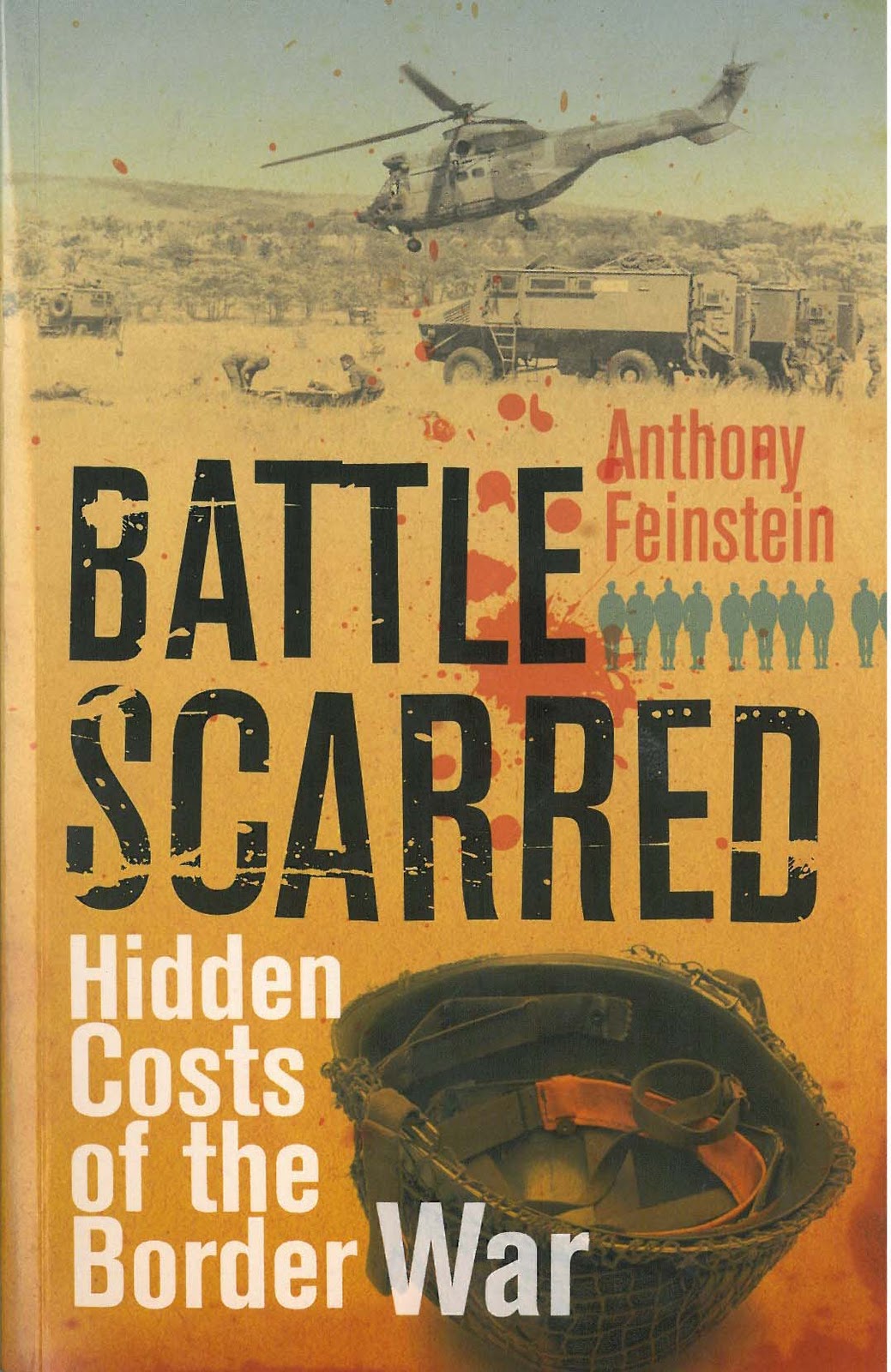
Battle Scarred: Hidden Costs of the Border War by Anthony Feinstein, Tafelberg

There is a world of sadness wrapped up in these walls. The psychotic patients, floundering in another dimension, are unaware of their plight. Their families see it all, though. When Mom and Dad arrive at the gates to pick up their lost son, their worry lines run deep, shoulders slump and anxiety makes their eyes dart like pinballs. The army knows there is no way back for these boys. Damaged goods must be returned.”

There are few choices for white men of conscript age in 1980s South Africa: choose to endure army training, and subsequent call-ups after that; proclaim yourself a conscientious objector and endure three years in jail; or leave, knowing you will never be able to return, or not without paying your dues to the state.

Anthony Feinstein trains as a doctor, and considers his options while taking violin lessons in Paris after winning a prestigious music prize. But the army has not forgotten him. He returns. He’s a doctor, two years should pass quickly. After basic training in which he learns that he is “lower than snake s***”, he chooses to go into plastic surgery, but the posts are full, and he’s assigned to psychiatry, the letters “PS” for psychiatry following just after PL for plastic surgeon. “The army decides I am to be a psychiatrist,” Feinstein writes, and so begins a meagre training in an army hospital, the place of sadness.

And then a different sort of hell begins. Feinstein discovers that he is to be posted to Oshakati in the then South West Africa, ordered to treat soldiers emotionally wrecked by their time in the Border War. It’s a place of unbelievable heat, and summer has yet to set in. But worse than that is the palpable sense of disillusionment and inevitability, “No one said war would be easy,” writes Feinstein. “Over and over this little homily is sung. It’s the stock response to every piece of bad news – landmine kills three, signalman hangs himself, sapper slashes throat, plane crashes, gas tank explodes.” The hot, sluggish days go on. Among the cases he treats, Feinstein encounters schizophrenia in a young soldier, and also counsels a traumatised abused wife of an army major.

Before long he finds himself in another hell in the bush, Tsandi, the baking pit of a tented camp, where he tastes fear as he’s flung into the heart of battle for the first time. The only escape: “You cannot step back from the group in Tsandi. There is simply no space for it. Only one’s thoughts are private and often they make bad company. So best to hang around the icebox and dip in for amnesia, which is what I do, following the lead of those more experienced.”

Throughout this powerful account of life in the army, Feinstein’s wry, witty and at times droll voice narrates the story in a compulsively, compelling manner.

The horrors of life in the army are laid bare, the brutality and the cruelty unfolding under his gentle pen. Musician, doctor, Jew, the combination couldn’t be worse in a regime designed to crush. Feinstein makes for a sympathetic character in his own real-life story; far from crushed, he nevertheless chooses to make his life elsewhere, beyond the borders of a SA gripped in rooi gevaar 1980s paranoia.

This memoir is a highly readable and recommended addition to the canon of stories emerging about life in apartheid’s army.

First published in The Sunday Independent, January 15 2012

Tuesday, December 27, 2011

Yewande Omotoso, Arja Salafranca and Others Highlight Their Favourite Travel Spots

Ahead of the end of year break, IOL Travel has compiled a list of the ten best getaway spots as chosen by writers, editors and other industry professionals. Contributors to this list include Books LIVE members Yewande Omotoso, who recommends Caledon’s Cape Idlewild Country Cottage, and Arja Salafranca, whose number one travel spot is the Utopia holiday resort in the Magaliesberg...Read more here

Tuesday, November 29, 2011

Arja Salafranca at Love Books,Melville


At the launch of Gillian Schutte's After Just Now at Love Books, Melville, Johannesburg. From left: Jill Nudelman, Arja Salafranca, Leigh Nudelman and Fiona Snyckers.

Friday, November 25, 2011

You simply do not exist unless you ‘like it’ online

I left my cellphone at home. Racing out to an appointment mid-afternoon, and then I was off to a writers symposium that began at five, there was no time to retrace my steps, although I thought of doing so and knew that I’d be caught in hideous peak hour traffic and would no doubt be late. So, reluctantly, I accepted that I was going into the world naked, so to speak.
And naked I felt. As others around me clicked – taking photos, tweeting comments and images, uploading same – I sat there, feeling powerless and cut off...read more here 

Wednesday, November 23, 2011

You can be anything you want to be

You woke up this morning
to hear that Freddie Mercury had died.
The brilliant blue light of dawn
came in through a parting in the curtain
and hurt your eyes.
You couldn't get back to sleep again.

In the background Freddie Mercury sang,
'You can be anything you want to be...'
over and over again.
You lay there,
remembering he'd told the press this weekend
that he had Aids.

Broken, cut-up lines of prose to
indicate our horror.
By hiding it in the background you
can forget about it,
stop worrying whether you can catch it from
a toilet seat or a kiss.

You make coffee and brush your teeth
watching the trees grow more emphatic
in the blue morning air.

He died of pneumonia,
it's all over the radio.

Can't smear blood over doorsteps to
indicate someone's died.
It's a clean antiseptic world,
you can't find the plague in filthy streets,
or engorged rats.
Instead you can watch the living corpses on TV.
Bared eyes enormous in concentration camp faces,
teeth large as rabbits.
The picture sticks like wet dough in your throat.
You shove it down with water
and try to swallow.

In the background Freddie Mercury sings,
You can be anything you want to be,
you can be anything you want to be.

The Milky Way fairytale

The constellation looked like a small cluster of cotton wool through the telescope. “Relax your eyes,” said astronomer Vincent Nettman. I didn’t know how to relax my eyes, I strained a bit more, clouds were coming, obscuring even the brightest object in the sky, the waning moon, and I joined my friends inside instead...Read more here

Saturday, November 19, 2011

The Road to Publishing

I swung into Wits University’s Senate House in February a few years ago. It was a hot summer’s day. Clutching books, a bag, sunglasses looped around my fingers, the university was teeming with students, noise, life, there was a palpable energy to the place. I’d been given my student number – or rather, the faculty of Humanities had simply re-activated my old number, beginning with the numeral 90 – for 1990, the year I registered as an undergrad student at Wits. It was astonishing to realise that it had been 19 years ago that I had first became a student, started studying literature and psychology; and that some of these students milling around me had only been born that year, the year I was eighteen...Read more here

Friday, November 18, 2011

At the Vodacom Journalism Awards 2011


With Janet van Eeden, regional winner at the Vodacom awards, and veteran journalist Sophie Tema. 

Sunday, November 13, 2011

Six poems on Peony Moon

Arja’s first poem was written at the age of ten – and detailed the grim effects of typhoid, a subject she knew nothing about. Things have changed since then. Her first poetry collection, A Life Stripped of Illusions, won the 1994 Sanlam Award, her second collection is The Fire in which we burn, while Isis X (Botsotso) contains a mini collection....Read more here